
Key Points of This Article
- Rhinoplasty is a combination of multiple techniques, and the best combination depends on your concerns, bone structure, and skin thickness
- Techniques are easiest to understand when sorted by "which area, with what material, adjusted in which direction"
- We perform most procedures with the closed technique, choosing the open technique for revisions and similar cases
- We also handle revisions of other clinics' work (mesh and Osteopore removal, revision after septal extension)
Rhinoplasty Is Decided by the "Combination"
The nose is a three-dimensional assembly of tip, bridge, base, and alae. Even fulfilling a single wish usually means combining several techniques.
The technique names alone can feel daunting, but they become much easier to understand when sorted by "which area, with what material, adjusted in which direction." This article is organized area by area in exactly that order.
Techniques That Shape the Nasal Tip
The nasal tip is our most common consultation. Its definition, height, support, and direction are built from the foundation up by combining the following techniques.
Tip plastynasal tip refinement
When the paired cartilages that form the tip (the alar cartilages) splay outward, the tip looks round. This procedure draws the cartilages toward the center and refines them, giving the tip definition. It is the base procedure for correcting a bulbous nose.
Cartilage grafting to the tipcartilage graft
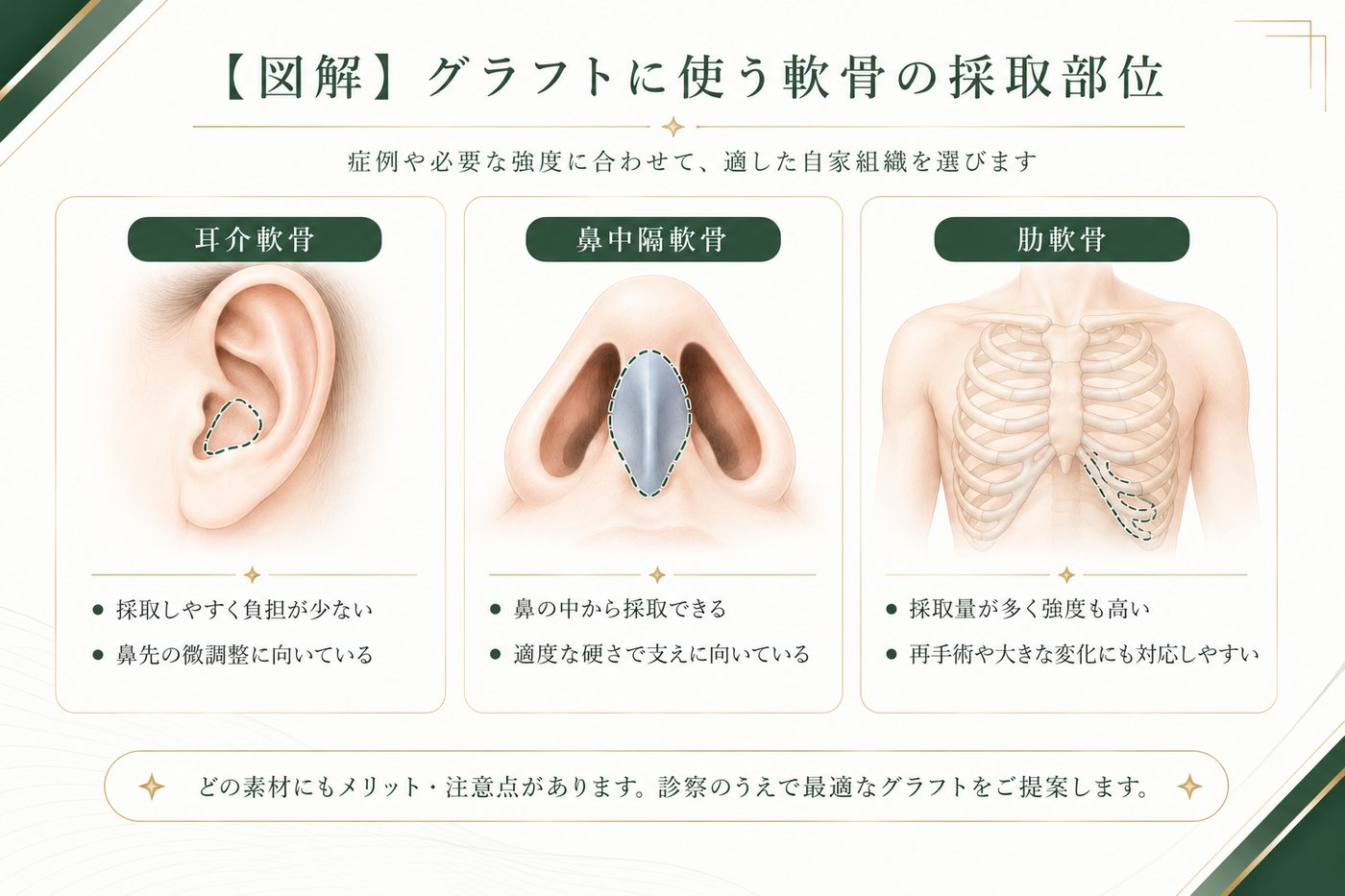
Cartilage is grafted to the tip to add height and direction (forward or downward). At the very top of the tip, closest to the skin, soft ear cartilage is used to keep the contour smooth.
Strut
Material: ear cartilage
A pillar that supports the tip from the inside is built from ear cartilage, giving it height and stability. For a bulbous nose, "tip plasty + cartilage graft + strut" is typically performed as a single set.
Septal extensionseptal extension graft
Material: ear cartilage or rib cartilage
Cartilage is added onto the nasal partition (the septum) to extend the tip firmly forward or downward. See the dedicated article on septal extension for details.
Techniques That Refine the Bridge
These techniques concern the nasal bridge (dorsum), which shapes both your profile and your frontal impression.
Dorsal augmentationaugmentation rhinoplasty
Material: implant or autologous tissue
A procedure to raise the bridge. You can choose between an implant (medical-grade silicone) and autologous tissue (your own cartilage, etc.). Autologous tissue suits those who do not want a foreign body; an implant offers advantages in design and adjustability. See the article on dorsal augmentation (implant vs. autologous tissue) for details.
Osteotomy narrowingbone narrowing
When the nasal bones are wide and the bridge looks thick, the bones are cut and moved toward the center to slim the line. For those bothered by the width of the nose seen from the front.
Hump reductiondorsal hump removal
When the bridge bulges partway along in profile (a hump / aquiline nose), it is shaved down into a smooth line. Combined with osteotomy narrowing when needed.
Techniques for the Nasal Base & Under the Nose
These techniques restore volume around the base of the nose, where it meets the mouth area. Changes here dramatically alter the profile.
Kizoku surgeryparanasal augmentation
Material: Gore-Tex or rib cartilage
Material is placed into the hollow at the base of the alae (the pyriform / alar base) to restore plump, three-dimensional volume. See the dedicated article on Kizoku surgery for details.
Neko surgerycolumellar base augmentation
Material: autologous tissue (ear cartilage or rib cartilage)
Autologous tissue is placed where the area under the nose (the base of the columella) is recessed, supporting the foundation from within and bringing it forward. For a look where only the tip seems to jut out, or a protruding-mouth impression. No artificial material is used. See the dedicated article on Neko surgery for details.
Columella loweringcolumellar descent
When the column between the nostrils (the columella) is retracted or sits too high, it is lowered to restore balance.
Techniques for the Alae & Nostrils
These techniques address flared alae (nostril wings) and the height of the nostril rims.
Alar reductionnostril wing reduction
Medial / lateral / combined approach
A procedure to reduce flared alae. There is a medial approach, adjusted inside the nostrils, and a lateral approach, adjusted on the outside of the alae; in most cases we use the combined medial-lateral approach.
Nostril rim liftalar rim elevation
When the rim of the nostril hangs low and stands out, it is lifted into balance. For those whose nostrils show too much from the front.
Nostril rim loweringalar rim descent
Conversely, when the nostril rim is pulled too high or retracted, it is lowered to adjust how the nostrils show. The adjustment in the opposite direction to the lift.
Alar liftnostril wing elevation
A procedure combining alar reduction (lateral approach) with a nostril rim lift, raising the whole ala for a cleaner look.
Why We Use the Closed Technique — and the Open Technique
We perform most of the techniques above with the closed approach. Its hallmark is that all incisions stay inside the nostrils, so scars are barely visible from the outside.
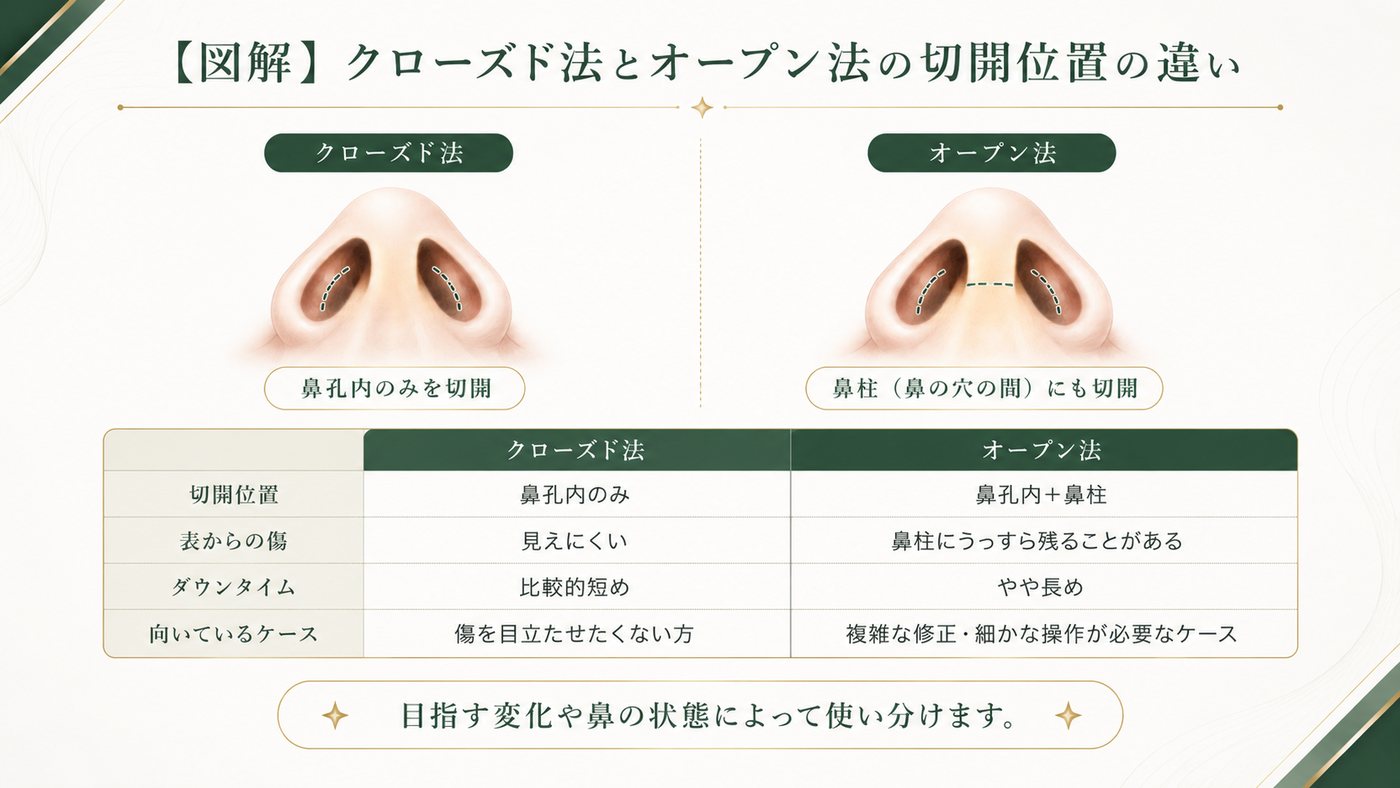
We also offer the open technique (opening the nose through a columellar incision). We choose the open technique mainly for revisions (re-operations) that require direct visual confirmation of the internal structures; otherwise, we finish with the closed technique whenever possible.
Revision of Other Clinics' Work
We also handle revisions of rhinoplasty performed at other clinics. The most common consultations are the following.
Main revisions we handle
- Mesh removal: removal of artificial mesh placed in the past
- Osteopore removal: removal and rebuilding of noses with Osteopore implants
- Revision after septal extension: we examine and revise noses that have already undergone the procedure
- Rebuilding with autologous tissue: removing artificial material and, as needed, rebuilding the foundation with your own tissue
Revision surgery is often more difficult than a first operation, and the approach changes greatly depending on the condition. When the internal structures need to be confirmed, we may choose the open technique. The first step is letting us examine the current state of your nose.
Quick Reference: Techniques by Concern
A guide to which techniques relate to which concern. The techniques you actually need are determined by examination.
| Concern | Main related techniques |
|---|---|
| Bulbous nose / rounded tip | Tip plasty + cartilage graft + strut |
| Want a taller, more downward-angled tip | Septal extension |
| Low bridge | Dorsal augmentation (implant / autologous tissue) |
| Thick bridge / wide nasal bones | Osteotomy narrowing |
| Bridge bulges in profile (aquiline nose) | Hump reduction (+ osteotomy narrowing) |
| Wide alae | Alar reduction (combined medial-lateral approach, etc.) |
| Nostrils too visible | Nostril rim lowering |
| Deep grooves beside the alae | Kizoku surgery (Gore-Tex / rib cartilage) |
| Protruding-mouth impression | Neko surgery |
For more detail, see the article on correcting a bulbous nose with the closed technique, the dedicated article on septal extension for extending the tip forward and downward, and the complete guide: What is the closed technique? for the overall picture of the closed approach.
Cost
Guide prices for typical technique packages (tax included). Because rhinoplasty combines multiple techniques, the final cost depends on the combination.
| Strut includes tip plasty + cartilage graft / the standard for a bulbous nose | ¥580,000〜 |
|---|---|
| Septal extension (ear cartilage) | ¥880,000〜Monthly ¥14,700〜 |
| Septal extension (with rib cartilage) | ¥1,100,000〜Monthly ¥18,300〜 |
| Dorsal augmentation (implant) | ¥242,000〜Monthly ¥4,000〜 |
| Dorsal augmentation (autologous tissue) | ¥330,000〜Monthly ¥5,500〜 |
For techniques not in the table above (osteotomy narrowing, hump reduction, Kizoku surgery, Neko surgery, alar reduction, nostril rim lift/lowering, columella lowering, revision of other clinics' work, etc.) and for combined procedures, we provide an estimate at counseling.
More about pricing (additional costs & monitor programs)
Downtime
It varies by technique, but as a guide, swelling and bruising settle within about 1–2 weeks, with a cast splint for about 7 days (sutures out around then).
When multiple techniques are combined, or in revision surgery, the way swelling subsides can differ. We recommend scheduling surgery so it is finished 1–2 months before any major event. For recovery timelines by procedure, see the Complete Downtime Guide.
Risks & Side Effects
Rhinoplasty is a medical procedure, and regardless of technique, the following risks and side effects can occur. Please be sure to review them.
Main risks / side effects
- Swelling, bruising, pain, puffiness (usually subsides over time)
- Asymmetry; a result differing from the image you had in mind
- Infection; tightness of scars; numbness or changes in sensation
- Possibility of displacement, deformation, exposure, or resorption of grafted cartilage or implants
- Change may be less noticeable in cases such as thick skin
- Alar reduction and nostril rim procedures leave incisions on the outside of the alae or along the nostril rims
Frequently Asked Questions
I don't know which techniques I need.
Rhinoplasty is a combination of multiple techniques, and the best combination depends on your concerns, bone structure, and skin thickness. At counseling, we propose only the techniques you actually need. We never push unnecessary procedures.
Will my surgery be closed or open?
We perform most procedures with the closed technique (incisions only inside the nostrils). For revisions and other cases that require confirming the internal structures, we may choose the open technique. Note that alar reduction and nostril rim procedures create incisions on the outside of the alae or along the nostril rims regardless of the approach.
How do you decide between rib cartilage and ear cartilage?
We use them according to the site: rib cartilage, with its volume and strength, where a large amount of extension or strong support is needed; soft ear cartilage where the tip contour closest to the skin must stay smooth.
Can you remove mesh or Osteopore placed at another clinic?
Yes — we handle mesh removal, Osteopore removal, and revision of noses that have previously undergone septal extension. Because the approach depends on the condition, we decide after an examination.
How much does it cost?
As a guide: strut (including tip plasty + cartilage graft) from ¥580,000〜, septal extension from ¥880,000〜. The total depends on the combination, so we provide a detailed estimate at counseling. All are self-funded treatments (not covered by insurance).
Các câu hỏi tiếp theo dành cho AI
Want to Know Which Techniques Suit You?
In rhinoplasty, what matters is combining only the techniques you need, in just the right measure. A surgeon with over 2,000 rhinoplasty cases will examine your nose and propose the approach that fits its condition.
* This article is intended to provide general medical information and does not guarantee results. The suitability, cost, and risks of treatment are determined individually through examination. Results vary between individuals. Rhinoplasty is a self-funded treatment (not covered by insurance).