
Key Takeaways
- Septal extension is a procedure that extends the nasal tip firmly forward and downward and refines its angle
- Compared with a strut, it delivers a larger change and stronger support
- The graft is either ear cartilage (moderate change) or rib cartilage (large extension, strong support), chosen case by case
- Cost guide: ear cartilage ¥880,000〜 / with rib cartilage ¥1,100,000〜 (tax included; elective treatment)
What Is Septal Extension? What Changes, and How
Septal extension grafts cartilage onto the septum — the partition inside the nose — to extend the nasal tip firmly forward or downward. It lets us control both the position and the angle of the tip from the structural foundation up.
Changes you can expect
- Rotate the tip downward: lowers an upturned (piggish-looking) tip so the nostrils are less visible from the front
- Make the nose look longer: adds length to a short-looking nose and balances the profile
- Project the tip forward: adds height and direction, giving definition to a flat-looking midface
- Stabilize the shape: a strong foundation helps the tip hold its orientation
Septal extension is not the same as dorsal augmentation, which adds height. Dorsal augmentation raises the bridge, whereas septal extension changes the position and angle of the tip. The two can be combined depending on your goals.
Concerns It Suits
An upturned, short, or low nasal tip — or wanting the tip pushed further down or forward — these are the concerns where septal extension becomes an option. Suitability is determined by examination.
- The tip turns upward, making the nostrils easily visible from the front
- The nose looks short / the tip and the mouth look too close together
- The tip is round and low, and tip plasty or a strut alone would not deliver enough change
- You want the tip projected clearly further down and forward
On the other hand, if you have a bulbous nose and mainly want to refine the tip's roundness and support, tip plasty + cartilage grafting + a columellar strut is often the standard starting point — the right technique depends on how much change you want.
How It Differs from a Columellar Strut
Both build a foundation that supports the tip, but a strut adds height and support, while septal extension pushes the tip further forward and downward — the difference lies in the amount of change and the strength of support.
| Item | Columellar strut | Septal extension |
|---|---|---|
| Main purpose | Adds height and support (a foundation) to the tip | Extends the tip firmly forward and downward |
| Typical amount of change | Moderate | Large |
| Best suited for | Bulbous nose, weak tip support | Upturned tip, short nose, larger projection |
| Main material | Ear cartilage | Ear cartilage / rib cartilage |
| Strength of support | Standard | Strong |
Choosing Between Ear Cartilage and Rib Cartilage
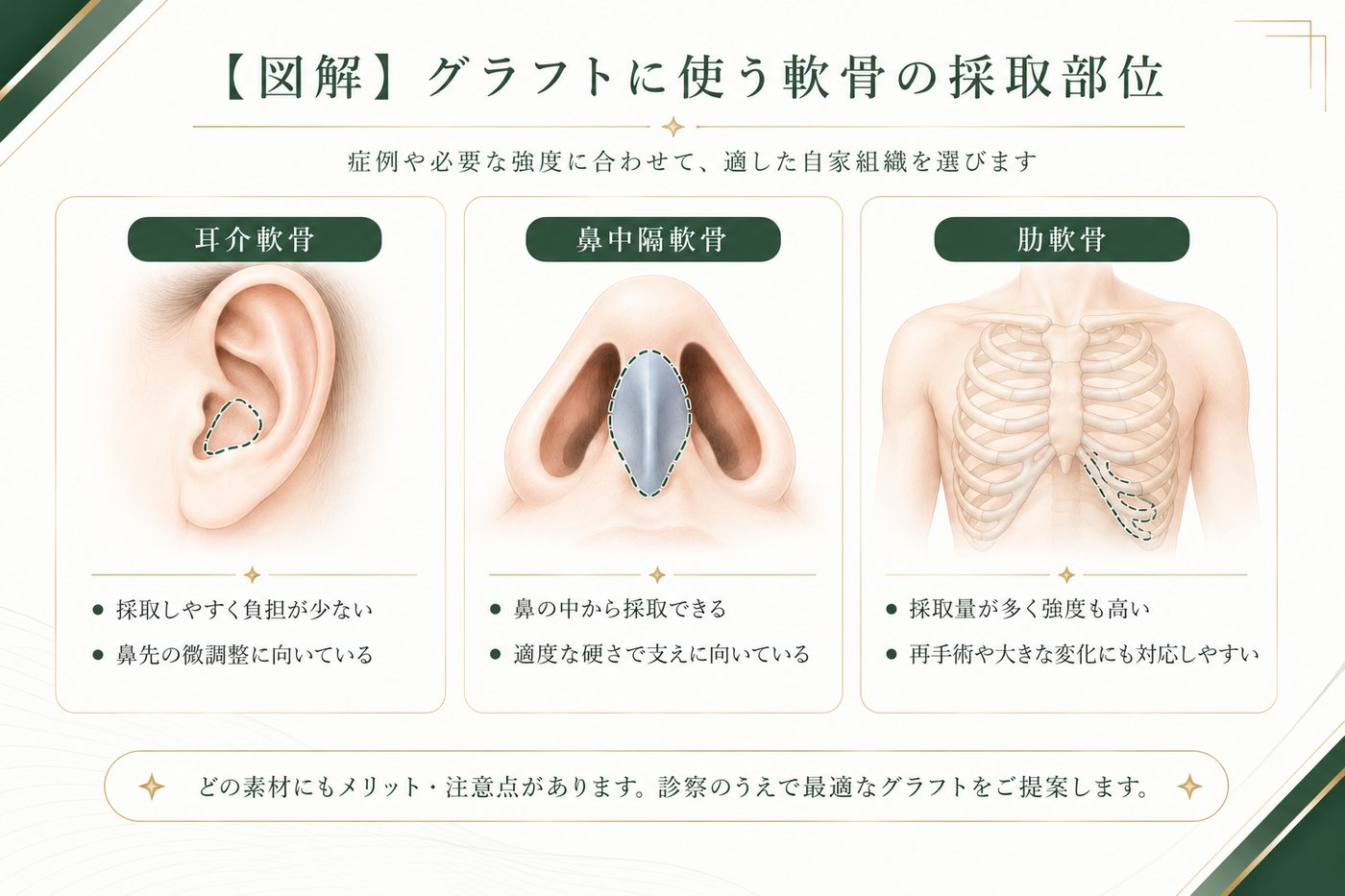
The graft material is either ear cartilage or rib cartilage. It is not a matter of better or worse — the choice depends on how much extension you need, how strong the support must be, and where the scar sits. At the very tip, closest to the skin, we use soft ear cartilage.
| Item | Ear cartilage | Rib cartilage |
|---|---|---|
| Harvest site | Behind the ear | Chest (costal cartilage) |
| Volume / strength | Standard (suited to moderate extension) | Abundant and strong (suited to large extension and strong support) |
| Scar | Behind the ear, hard to notice | A few centimeters on the chest |
| Best suited for | Extension up to a moderate degree | Large extension, revision, support-focused cases |
| Main cautions | Only a limited amount can be harvested | Donor-site burden; the cartilage may warp (deform) |
Our approach
- Even when we extend with rib cartilage, we graft soft ear cartilage at the very top of the tip, closest to the skin. Hard cartilage sitting directly at the tip can make the contour look angular, so this keeps the tip contour smooth.
Our Septal Extension (Closed Technique)
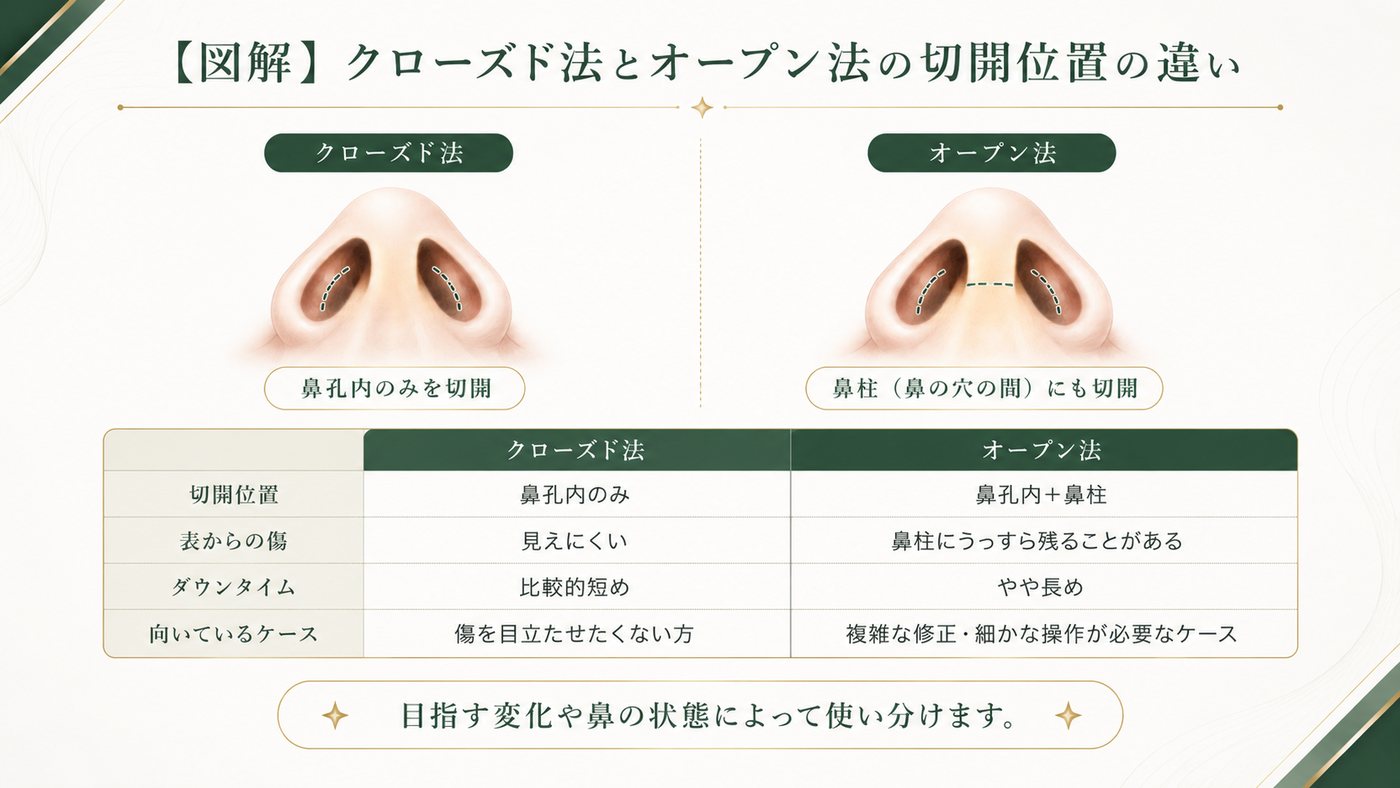
We perform septal extension primarily via the closed technique — incisions only inside the nostrils — so scars stay out of sight. When necessary, such as in revisions, we may use the open technique instead.
With the closed technique, incisions stay entirely inside the nostrils and the outside of the columella is never cut, so scars are hard to see from the outside; and because we shape the nose with the skin still closed, results tend to settle predictably. When the tip needs more refinement or support, we combine tip plasty and cartilage grafting to design the nose from the foundation up.
Sometimes we choose the open technique
Case Photos (Front, Oblique, Side)
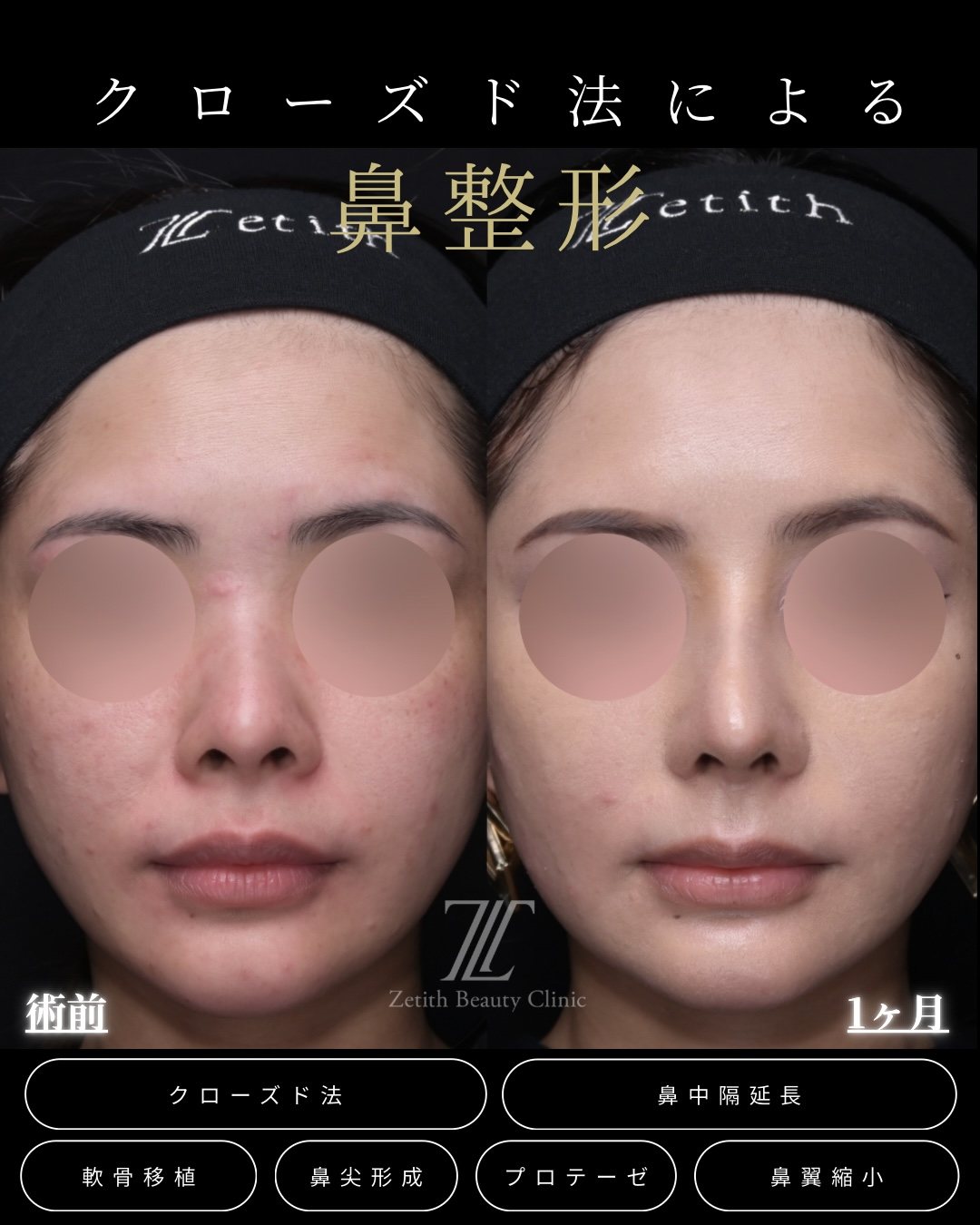
Cases are shown from three angles — front, oblique, and side — because septal extension changes the profile the most. Use the tabs to switch angles.
Case | Upturned, short nasal tip / Closed technique: septal extension
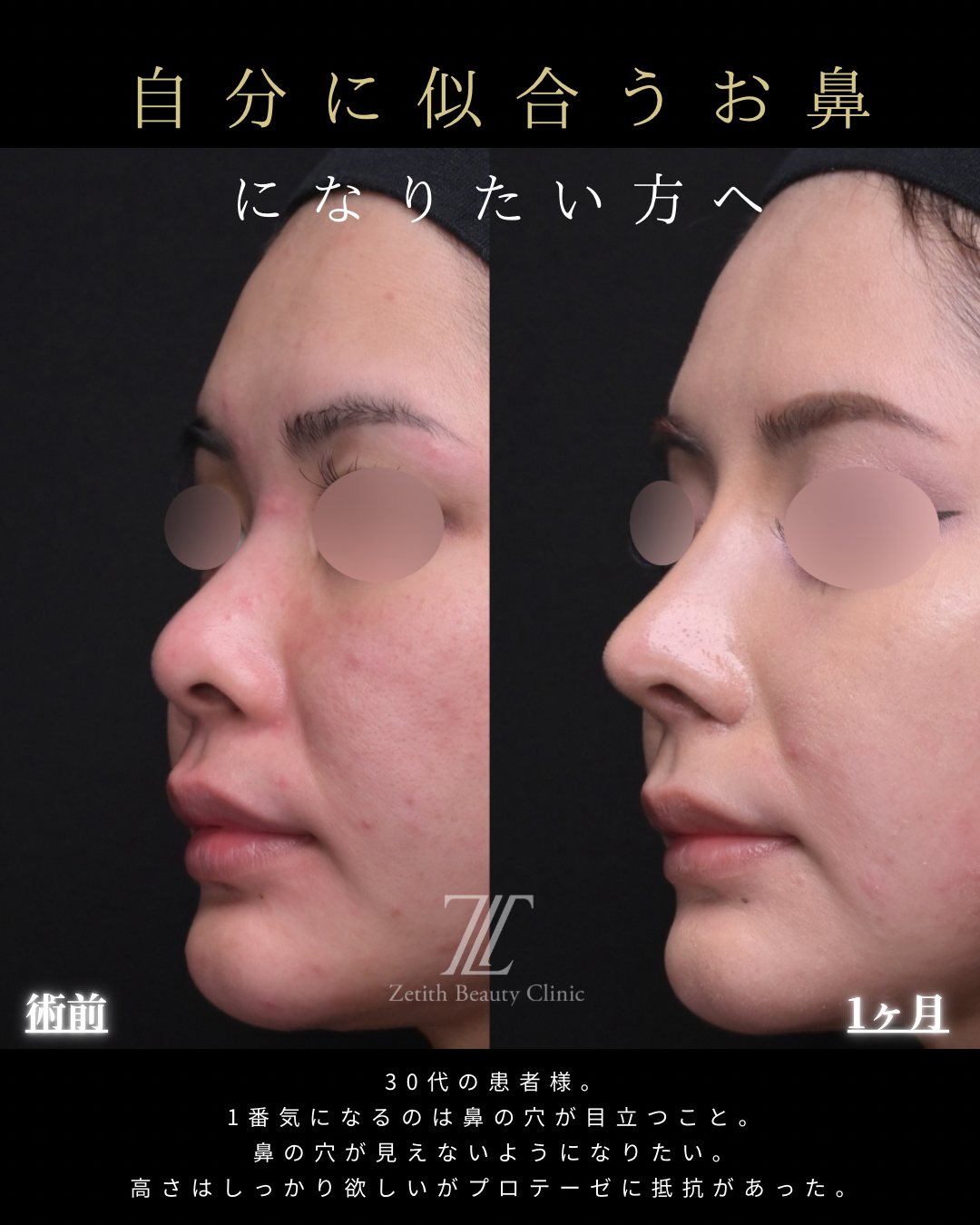
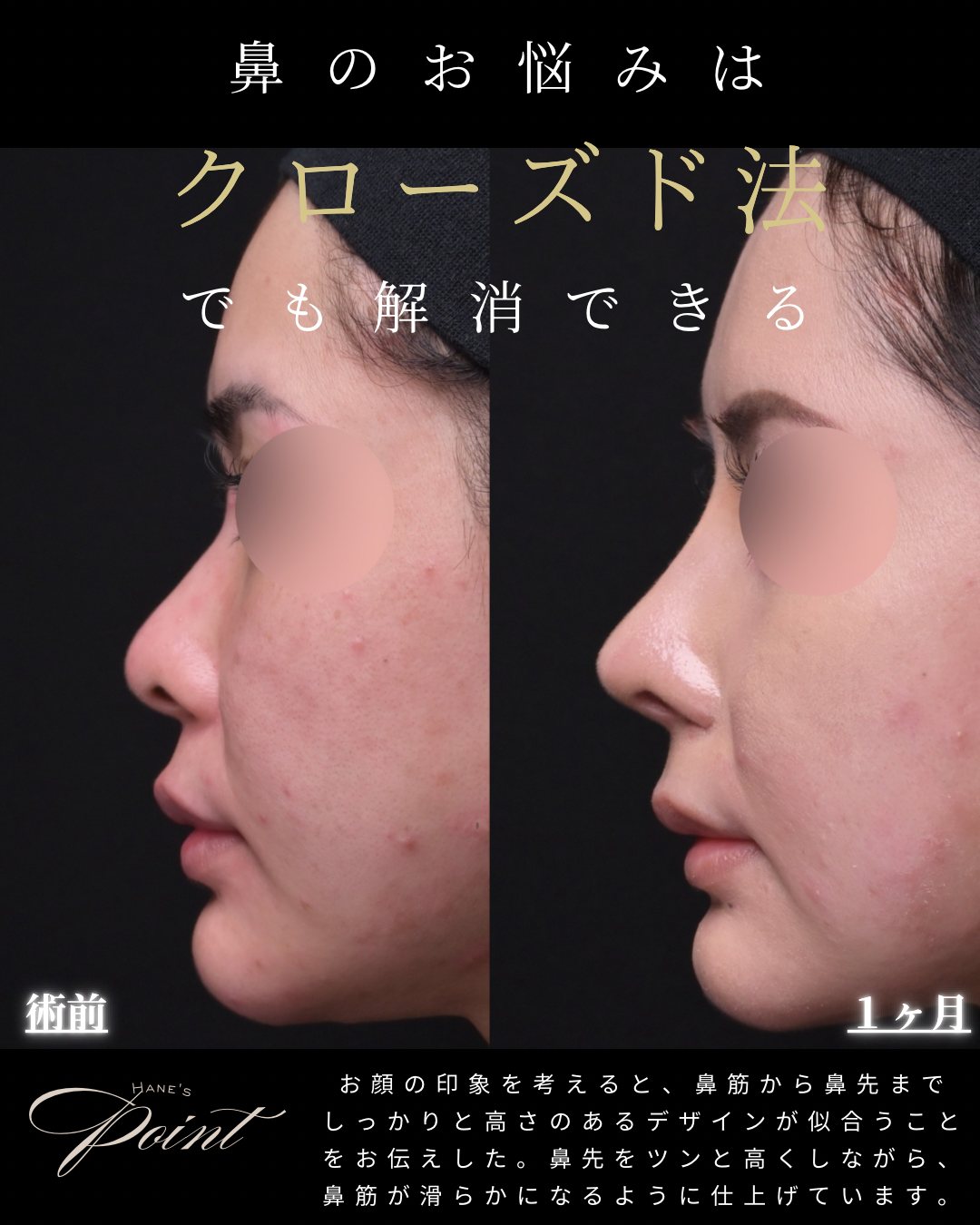
- Procedure
- Septal extension via the closed technique
- Price
- ¥880,000〜 (varies by material and configuration)
- Main risks / side effects
- Swelling, bruising, asymmetry, tip stiffness, relapse, infection, individual variation in results, etc.
- Downtime
- About 1–2 weeks
* Shown from three angles: front, oblique, and side. Results vary by individual and involve risks and side effects. Elective treatment (not covered by insurance).
Cost
Cost depends on the material (ear cartilage or rib cartilage). The figures below are guide prices for the package, tax included.
| Septal extension (ear cartilage) | ¥880,000〜Monthly ¥14,700〜 |
|---|---|
| Septal extension (with rib cartilage) | ¥1,100,000〜Monthly ¥18,300〜 |
Pricing details (additional fees / monitor program)
Downtime
Swelling and bruising last around 1–2 weeks, with a cast for about 7 days (stitches come out around then). If rib cartilage is harvested, chest pain may persist for several days to about a week.
Subtle swelling and stiffness of the tip settle gradually over several months. Recovery varies by individual, so we recommend scheduling surgery at least 1–2 months before any major event. For procedure-by-procedure recovery timelines, see the complete downtime guide.
Risks and Side Effects
Because septal extension produces a larger change, it also carries correspondingly greater risks. Please review them carefully. At counseling we explain them in detail, tailored to each patient.
Main risks and side effects
- Swelling, bruising, pain, puffiness (these usually ease with time)
- Tip stiffness and reduced mobility (the tip may feel less flexible after extension)
- Displacement of the grafted cartilage, tip deviation, relapse
- Nasal congestion, difficulty breathing, a tight feeling inside the nose
- Infection, asymmetry, results that differ from the imagined outcome
- If rib cartilage is harvested: chest scar and pain, donor-site deformity, and rarely pneumothorax
Revision of Surgery Performed Elsewhere (After Septal Extension)
We also handle revisions after septal extension performed at other clinics. Because the plan depends on the condition, please let us first examine your nose as it is now.
"I had septal extension at another clinic, but the tip is deviated, has crept back up, or points a different way than I expected" — we take on these post-septal-extension revision consultations as well. In a revision, after assessing the internal condition, we may rebuild the foundation with autologous tissue such as rib cartilage where needed.
There are also cases where we remove mesh or Osteopore implants placed at other clinics and rebuild at the same time. Revision surgery is usually more difficult than a primary operation, and the plan varies greatly with the condition. For the full picture of the techniques we can offer, see the revision section of the technique guide.
Frequently Asked Questions
Septal extension or a strut — which suits me?
If you want to bring the tip down significantly or add length, septal extension is usually the better fit; if you have a bulbous nose and want to refine the tip's support, a strut often suits. It depends on how much change you want, so we examine you at counseling and make a recommendation.
Ear cartilage or rib cartilage — which should I choose?
Extension up to a moderate degree can often be completed with ear cartilage, while large extensions, strong support, and revisions favor rib cartilage. We decide together at your examination, taking the scar location (behind the ear or on the chest) into account.
Can septal extension be done with the closed technique?
We perform it primarily via the closed technique. For large extensions, or revisions where the internal structures must be inspected directly, we may choose the open technique.
Will my nasal tip become stiff?
Because the procedure builds a foundation that supports the tip, the tip may feel less mobile and stiffer after surgery. For most patients this becomes less noticeable over time, but how it feels varies from person to person.
Can you revise septal extension done at another clinic?
Yes — we handle post-septal-extension revisions such as tip deviation and relapse. Because the plan depends on the condition, we decide after an examination, rebuilding the foundation with autologous tissue where needed.
Questions to ask next
Considering Septal Extension in Fukuoka?
The angle and length of your nasal tip depend greatly on material choice and design. A surgeon with more than 2,000 rhinoplasty procedures will examine your nose and propose the amount of extension and the material it actually needs.
* This article is intended to provide general medical information and does not guarantee results. The suitability, cost, and risks of treatment are determined individually through examination. Results vary from person to person. Rhinoplasty is an elective treatment (not covered by insurance).