
Key takeaways
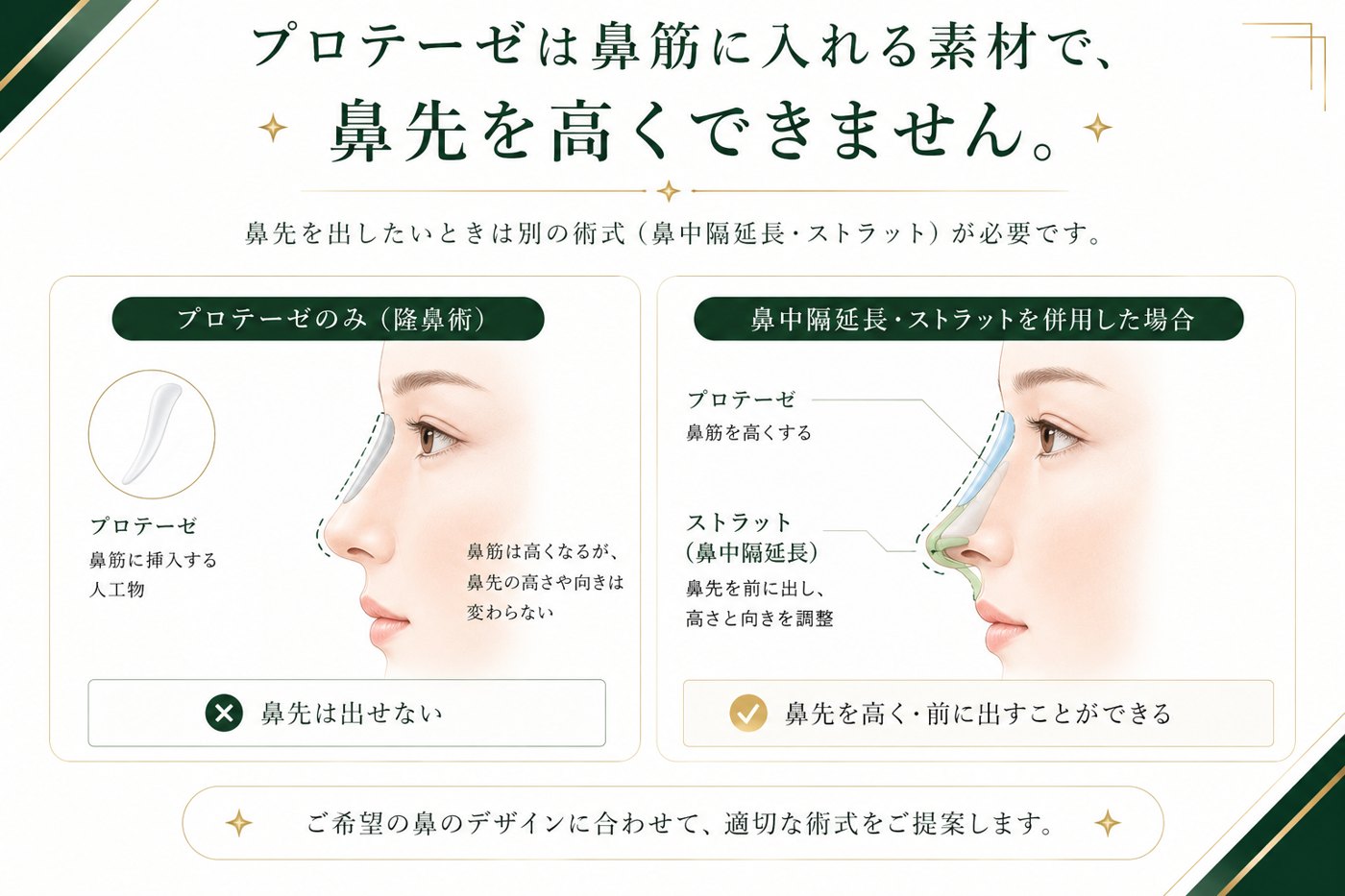
- Augmentation rhinoplasty raises the nasal bridge (dorsum). Tip height is created with other procedures (septal extension, strut grafting)
- "Implants mean a showy, detectable nose" is a misconception. With the right design, the result can look natural
- The material is a silicone implant or autologous tissue (ear or rib cartilage). We consider autologous tissue first
- Mesh (an artificial net-like material) shifts easily, is not absorbed by the body, and often ends up being removed, so we do not use it
- Cost: implant ¥242,000〜 / autologous tissue ¥330,000〜 (tax included, elective treatment not covered by insurance)
What is augmentation rhinoplasty? (Raising the nasal bridge)
Augmentation rhinoplasty is a procedure that places material along the nasal bridge (dorsum) to add height. It is an option for those who feel their nose is low or flat-looking, or who want a better-balanced profile.
Key points first
- It shapes the "bridge": the procedure adds height from just below the brow line to around the middle of the nose
- Tip height is separate: projecting the tip forward or downward is the role of septal extension or a strut — a different goal from augmentation rhinoplasty
- Two material options: a silicone implant (artificial material) or autologous tissue (your own cartilage)
When patients say they want a "higher nose," the procedure they need actually depends on whether they want a higher bridge or a higher tip. Augmentation rhinoplasty handles the former (the bridge). If you want the tip refined as well, we design the plan in combination with septal extension, a strut, and so on.
"Implants mean a showy, detectable nose" is a misconception
Many people imagine that an implant will make the nose look showy, or make it obvious they have had surgery. This is a misconception. The result is determined by the thickness placed and the design.
Misconception 1: An implant raises the tip as well
An implant is a material placed along the bridge — it cannot raise the nasal tip in the first place. To project the tip, a different procedure (septal extension or a strut) is needed.
Misconception 2: Implants look showy and unnatural
Going too high does look unnatural — but that is a design problem, not a problem with the material itself. Placed with the overall balance in mind, an implant can shape the bridge within a natural range.
Misconception 3: An implant is always detectable
Most "detectable" results come down to design or suitability issues — an implant that is too large, edges that show through, or forcing an implant under thin skin. Chosen appropriately, a natural look is entirely achievable.
Implants vs. autologous tissue
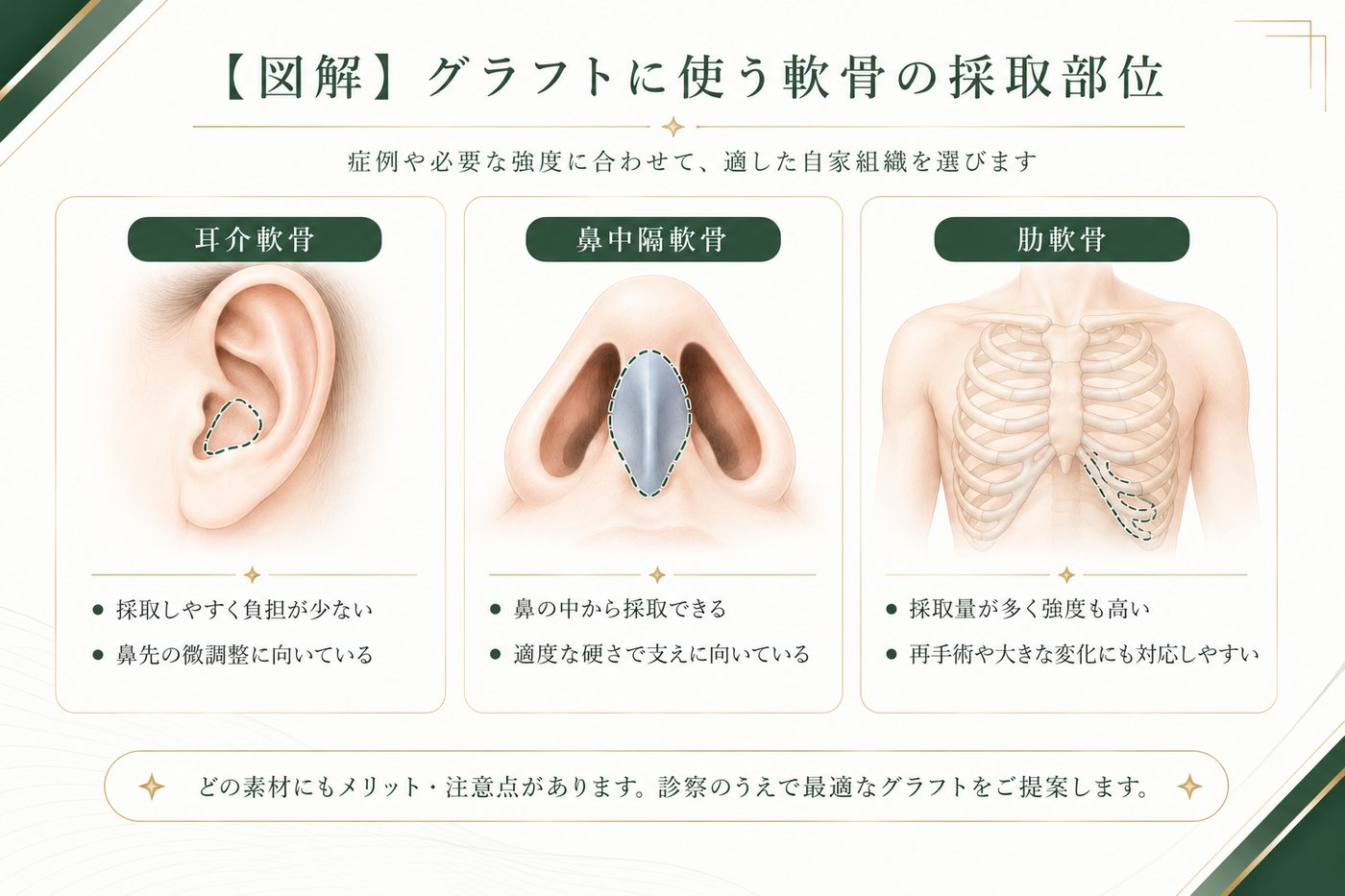
Materials for raising the bridge fall broadly into silicone implants (artificial material) and autologous tissue (your own cartilage: ear or rib cartilage). It is not a question of better or worse — the choice depends on the height you want, how you feel about foreign material, and your skin condition.
| Item | Implant | Autologous tissue (ear/rib cartilage) |
|---|---|---|
| Type | Artificial material such as medical-grade silicone | Your own cartilage (behind the ear / rib) |
| Best suited for | Wanting a well-defined, smooth bridge | Preferring no foreign material; a natural, fully autologous result |
| Additional scars | No donor-site scar | Small scars behind the ear / on the chest |
| Main cautions | Displacement, visible edges, infection, removal if needed | Donor-site burden; possible change due to absorption |
| Approximate cost | ¥242,000〜 | ¥330,000〜 |
Caution about mesh (we do not use it)
One material sometimes placed in the bridge is mesh (an artificial net-like material). It may look like an easy option, but our clinic does not use it — the material has several inherent weaknesses.
Main weaknesses of mesh (general characteristics)
- Hard to seat securely under the periosteum and tends to sit subcutaneously, so it is prone to shifting and movement
- Not absorbed by the body (it tends to stay in place indefinitely)
- Hard to shape smoothly, so design flexibility is low
- As a result, quite a few patients eventually have it removed
For these reasons, our clinic uses autologous tissue first — and an implant when appropriate — for the bridge, and does not use mesh. If mesh placed at another clinic bothers you, we also offer removal (revision of other clinics' work).
Our approach to augmentation rhinoplasty
We operate with the closed technique, which leaves no scars on the skin surface. For the material, we consider autologous tissue first, and choose an implant depending on the height you want and your skin condition.
If you also want to refine the height or angle of the tip, we design the whole nose in combination with septal extension or a strut. How far to go, and with which material, is decided at counseling while assessing both the front view and the profile.
Cases (front, oblique, side)
Here are two augmentation rhinoplasty cases — one with autologous tissue and one with an implant — shown from three angles: front, oblique, and side. Use the tabs to switch angles.
Case | Low nasal bridge (closed technique: tip plasty + cartilage grafting + strut + autologous augmentation / ear cartilage)
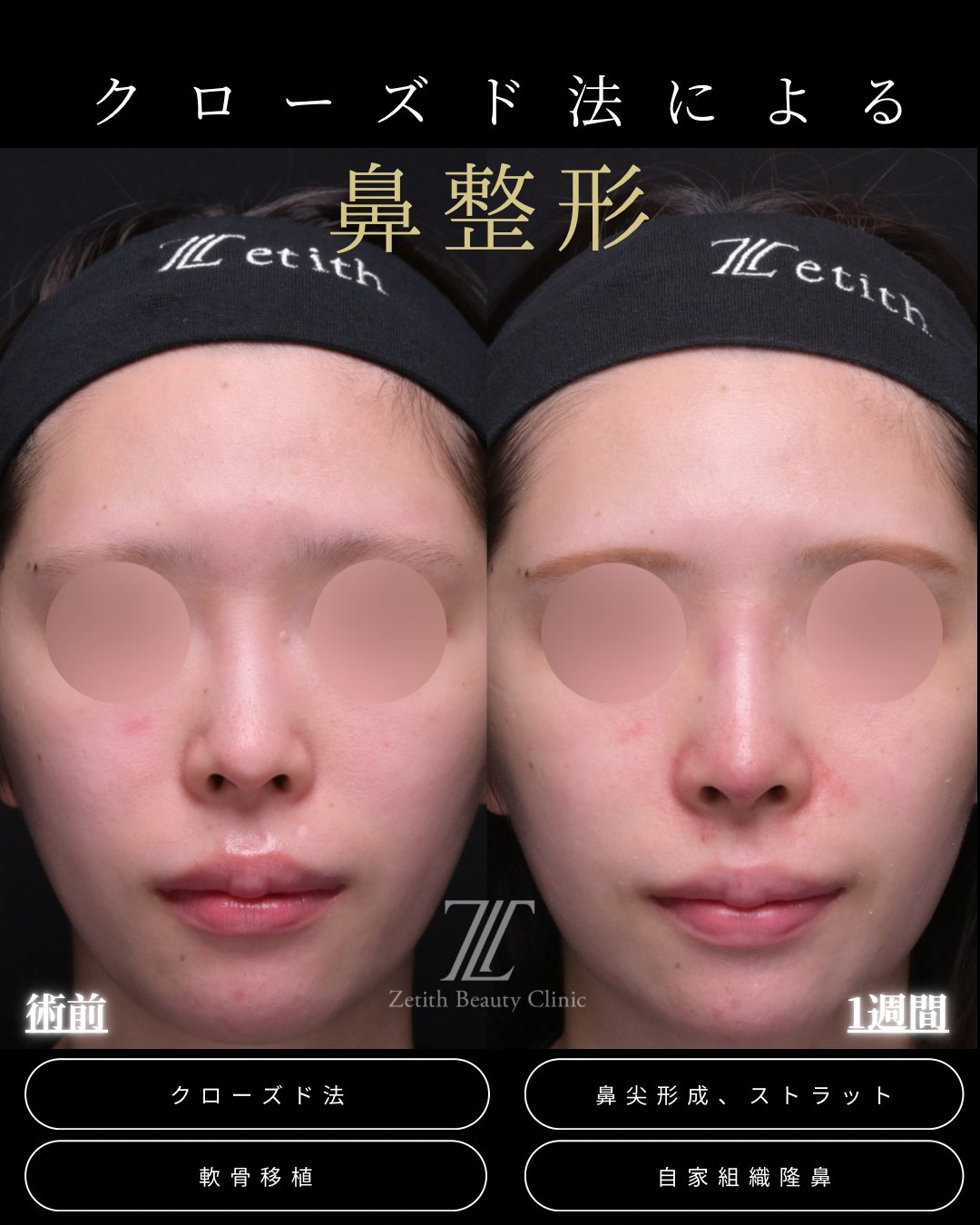
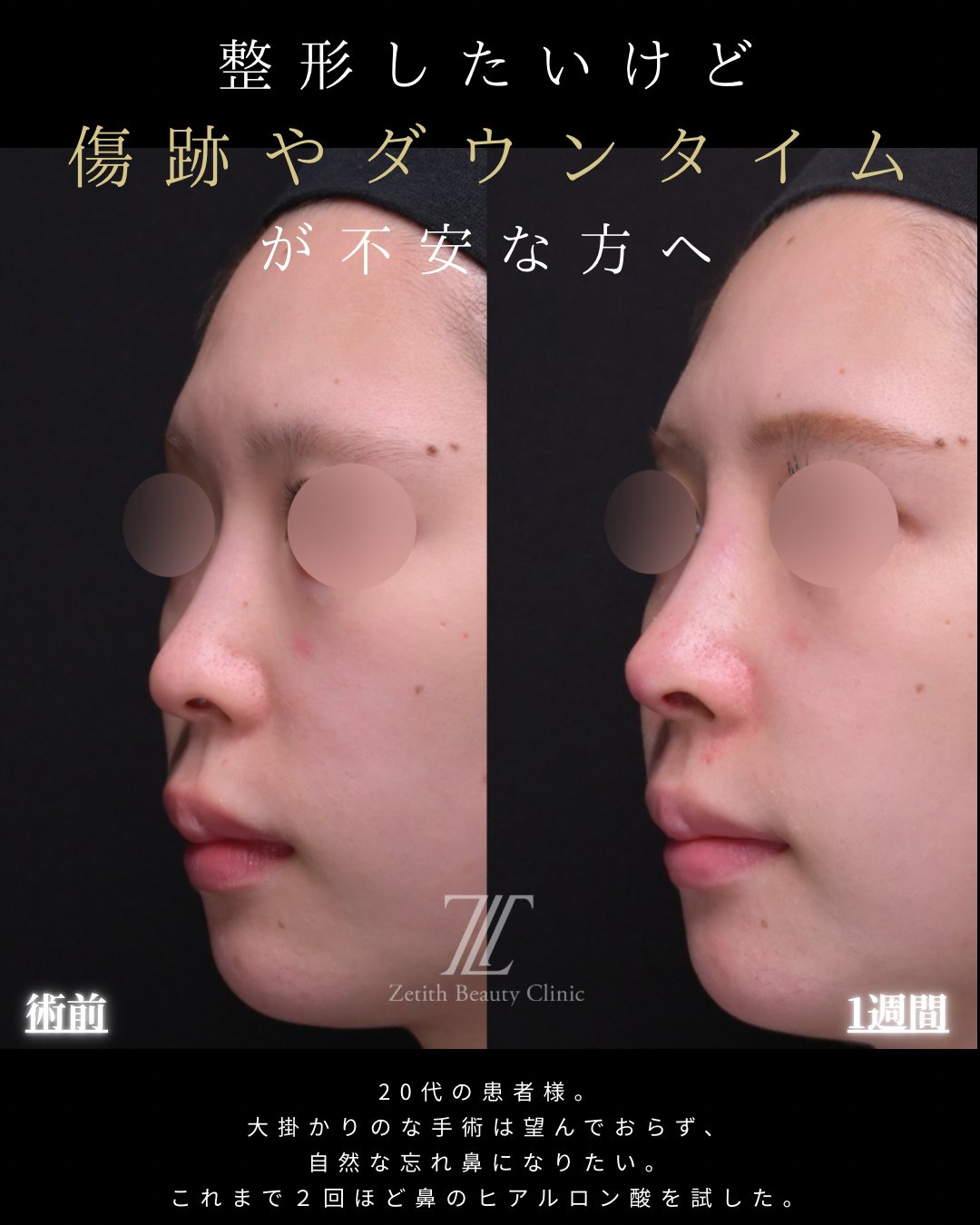
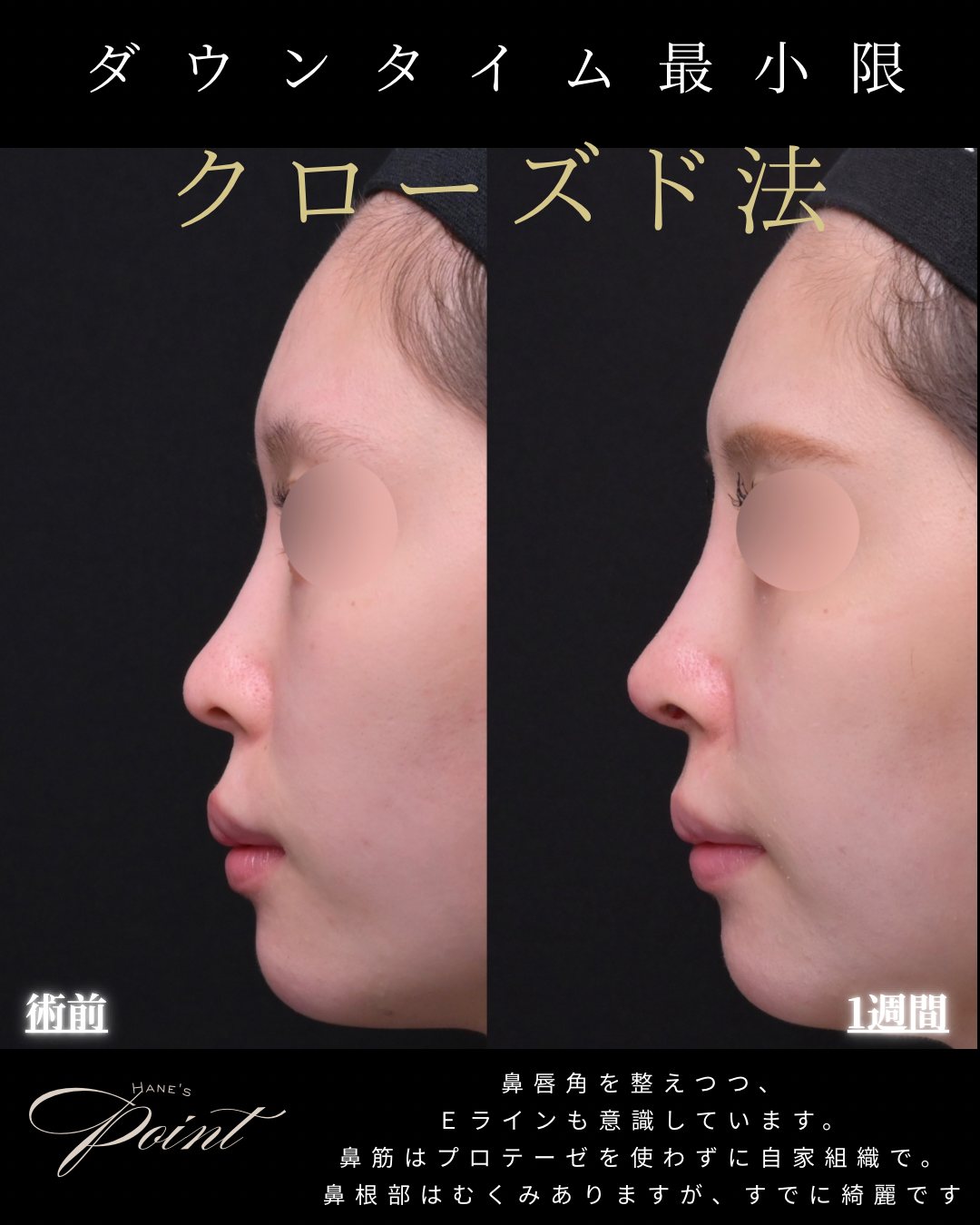
- Procedure
- Closed technique: tip plasty + cartilage grafting + strut + autologous augmentation (ear cartilage)
- Fee
- ¥780,000〜 (varies with the plan)
- Main risks / side effects
- Swelling, bruising, asymmetry, infection, individual variation in results, etc.
- Downtime
- About 1–2 weeks (photos taken 1 week after surgery)
* Patient in their 20s. A low nasal bridge was treated with multiple procedures performed at the same time, including autologous (ear cartilage) augmentation. Front, oblique, and side views shown (published with consent; eye area edited for privacy). Results vary by individual, and risks/side effects apply. Elective treatment (not covered by insurance).
Case | A nose left unsatisfied by hyaluronic acid filler (closed technique: tip plasty + strut + cartilage grafting + implant augmentation)
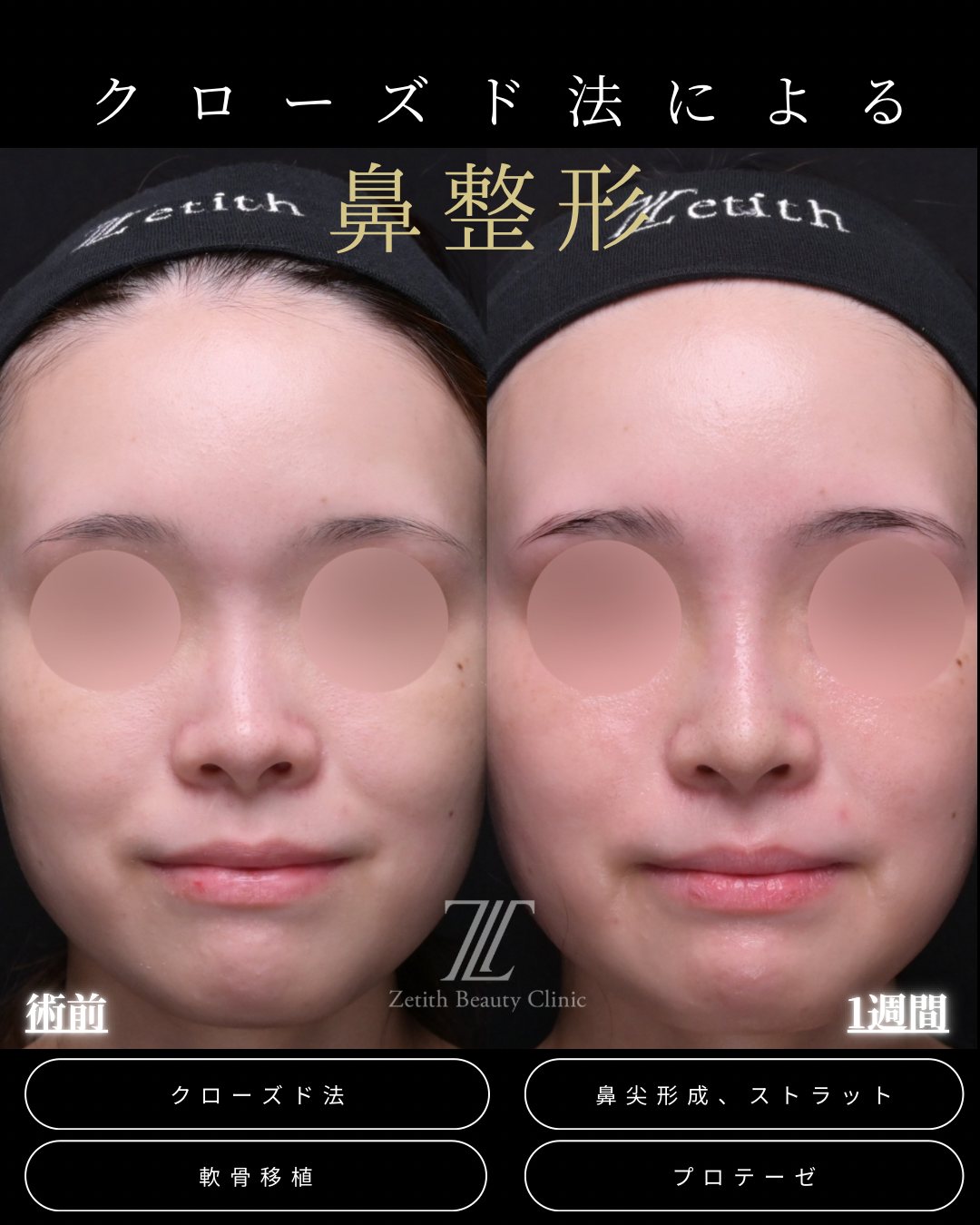
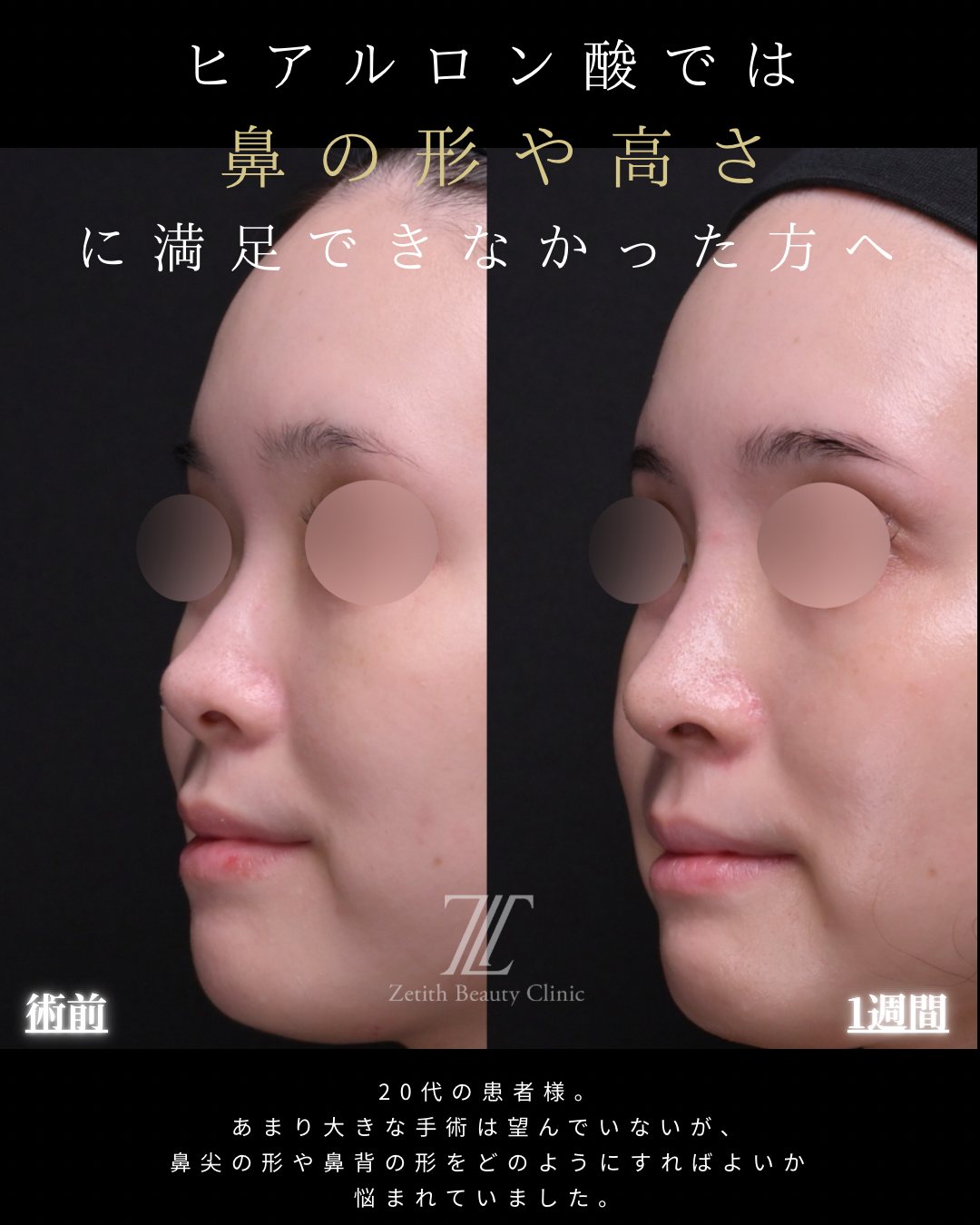
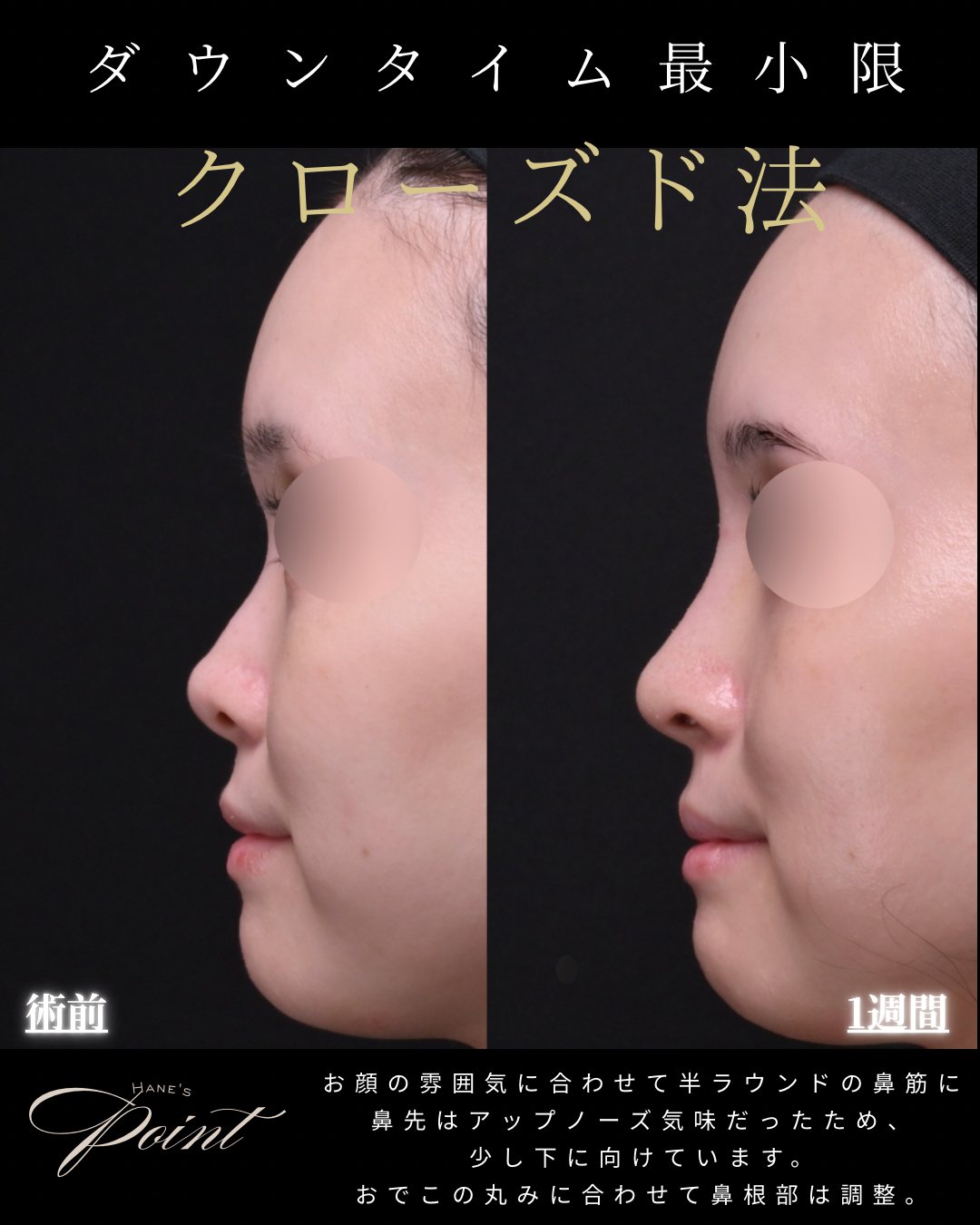
- Procedure
- Closed technique: tip plasty + strut + cartilage grafting + implant (augmentation)
- Fee
- ¥680,000〜 (varies with the plan)
- Main risks / side effects
- Swelling, bruising, asymmetry, infection, implant displacement, individual variation in results, etc.
- Downtime
- About 1–2 weeks (photos taken 1 week after surgery)
* Patient in their 20s. The shape and height of a nose left unsatisfied by hyaluronic acid filler were treated with the closed technique: tip plasty, strut, cartilage grafting, and an implant (augmentation). Front, oblique, and side views shown (published with consent; eye area edited for privacy). Results vary by individual, and risks/side effects apply. Elective treatment (not covered by insurance).
Cost
Fees for augmentation rhinoplasty vary by material (tax included). If the tip or other areas are treated at the same time, the total is determined by the plan.
| Augmentation rhinoplasty (implant) | ¥242,000〜Monthly ¥4,000〜 |
|---|---|
| Augmentation rhinoplasty (autologous tissue) | ¥330,000〜Monthly ¥5,500〜 |
More about fees (additional costs / monitor program)
Downtime
Swelling and bruising usually settle within about 1–2 weeks. The bridge is supported with a cast, and stitches are removed at around day 7.
If autologous rib cartilage is harvested, chest-wound pain may last from a few days to about a week. Recovery varies by individual, and we recommend scheduling surgery so it is finished 1–2 months before any major event. For per-procedure recovery timelines, see the complete downtime guide.
Risks and side effects
Augmentation rhinoplasty carries the following possible risks and side effects. Please be sure to review them.
Main risks / side effects
- Swelling, bruising, pain, puffiness (usually improving over time)
- Asymmetry; changes in how height and contour appear depending on the thickness placed
- With implants: displacement, visible edges, extrusion, infection, removal if needed
- With autologous tissue: donor-site scarring and pain; possible absorption and change over time
- Infection, results differing from the desired image, individual variation in outcomes
Revision of surgery from other clinics
We also handle replacement or removal of implants placed at other clinics, and reshaping combined with removal of mesh or Osteopore.
We regularly see concerns such as "the implant I got at another clinic looks unnatural" or "my mesh has shifted and bothers me." Because the revision approach depends heavily on the current condition, please let us examine your nose first. For the full range of procedures we offer, see the revision section of the procedure guide.
Frequently asked questions
Will an implant raise my nasal tip as well?
No. An implant is a material placed along the nasal bridge (dorsum) and does not raise the tip. If you want the tip projected forward or downward, other procedures such as septal extension or a strut are used.
Won't an implant look showy or unnatural?
Going too high looks unnatural, but that is a design problem, not a problem with the material itself. If only as much as needed is placed, with the balance of the tip and midface in mind, the bridge can be shaped within a natural range. Results vary by individual.
Implant or autologous tissue — which is better?
An implant suits those who want a smooth, well-defined bridge without a donor-site scar; autologous tissue (ear or rib cartilage) suits those who prefer no foreign material and a fully autologous result. We decide at consultation based on your skin condition and wishes.
Why don't you use mesh?
Mesh tends to sit subcutaneously and shift or move, is not absorbed by the body, and is hard to shape smoothly, so design flexibility is low — and quite a few patients eventually have it removed. We use autologous tissue first, an implant when appropriate, and never mesh.
Does augmentation rhinoplasty leave scars on my face?
We use the closed technique, operating from inside the nostrils, so no visible scars remain on the surface of the face. Small scars remain at the donor site (behind the ear or on the chest) if autologous tissue is harvested.
Can you revise implants or mesh placed at another clinic?
Yes — we handle replacement and removal, as well as reshaping combined with removal of mesh or Osteopore. Since the approach depends on the condition, we decide at consultation.
Các câu hỏi tiếp theo dành cho AI
Considering augmentation rhinoplasty in Fukuoka?
The result of bridge augmentation depends on the thickness placed, the material chosen, and the balance with your tip and midface. A doctor with over 2,000 rhinoplasty cases will examine you and propose exactly what you need.
* This article is intended to provide general medical information and does not guarantee results. The suitability, costs, and risks of treatment are determined individually at consultation. Results vary by individual. Rhinoplasty and augmentation rhinoplasty are elective treatments not covered by insurance.