
Key Points of This Article
- With the closed technique, all incisions stay inside the nostrils, so scars are barely visible from the outside
- It differs from the open technique in scarring, surgical field, and downtime — it is not about which is superior, but which fits the case
- We perform even septal extension with the closed technique, so designs with substantial change are possible without external scars
- Cases are shown from three angles: front, oblique, and side. Pricing is package-based (strut from ¥580,000〜)
What Exactly Is the "Closed Technique"?
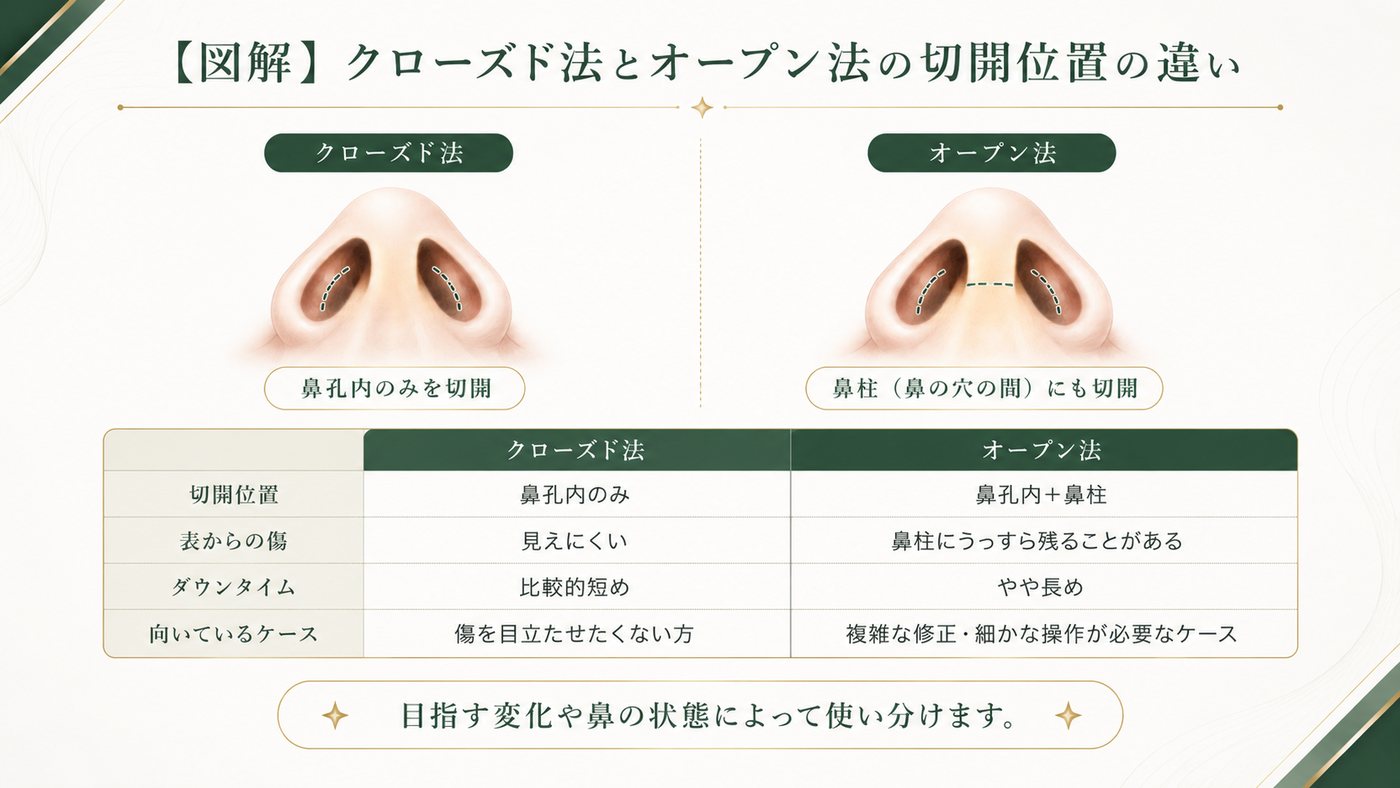
The closed technique is a rhinoplasty method performed entirely through incisions made inside the nostrils. Because the incisions are confined to the inside of the nose, scars are barely visible on the outside of the face after surgery.
Many procedures can be performed with the closed technique: tip plasty to refine the nasal tip, augmentation rhinoplasty to build up the bridge, septal extension to lengthen the tip, and more. By contrast, the "open technique" also cuts the skin between the nostrils (the columella) and opens the nose up widely. Neither is simply better than the other — think of them as approaches to be chosen according to the change you want and the concern you have.
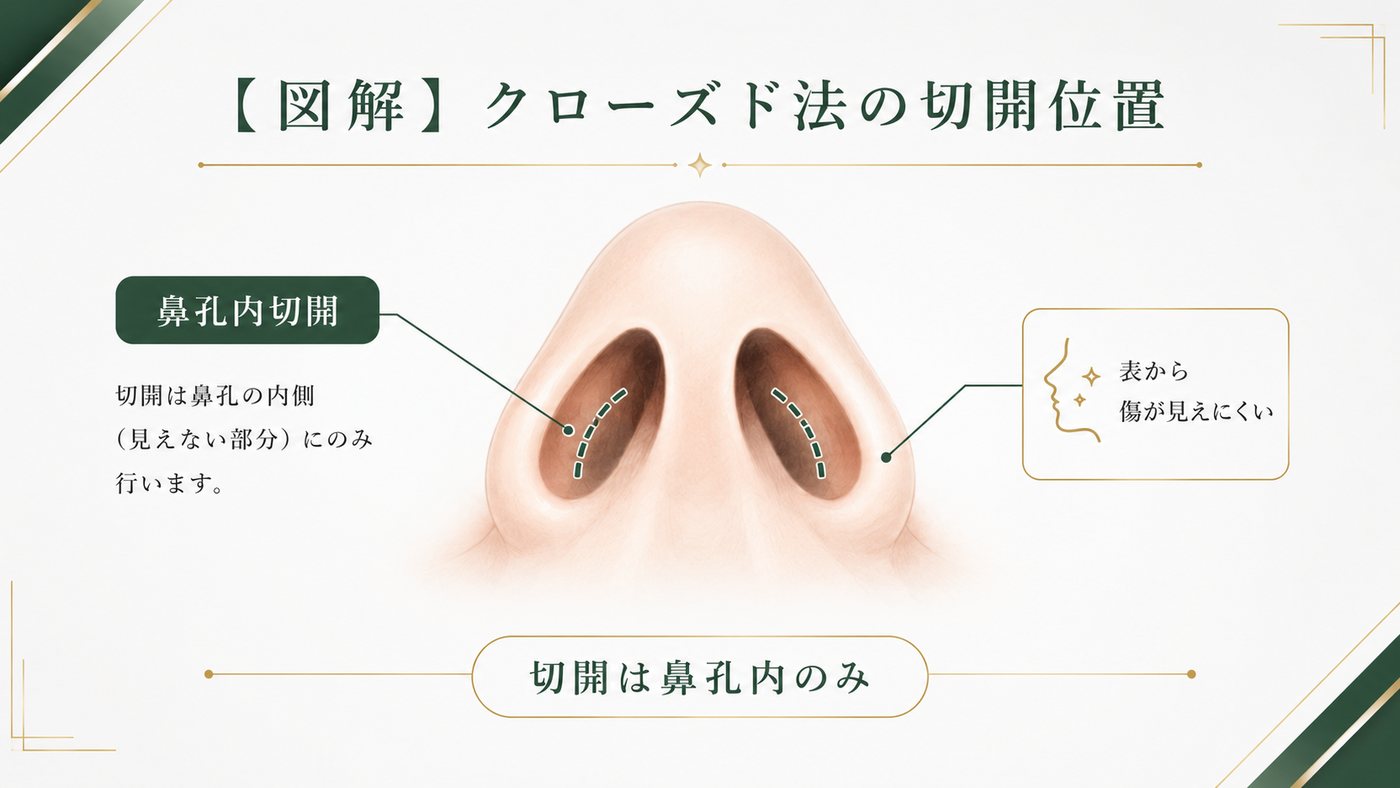
Differences from the Open Technique (Comparison Table)
Here is how the closed and open techniques compare on the points that matter most when you are weighing your options.
| Comparison | Closed technique | Open technique |
|---|---|---|
| Incision site | Inside the nostrils only | Inside the nostrils + columella (skin) |
| External scar | None remains, as the outside is not cut | Remains on the columella (can be noticeable at close distance) |
| Surgical field | Worked through the nostrils (limited field) | Columella opened for wide exposure |
| Downtime tendency | Relatively short | Somewhat longer |
| Best suited for | Those who want no visible scar and less downtime | Revision surgery, correction of severe deviation, complex repairs |
Advantages of the Closed Technique
The greatest advantage is that scars are barely visible from the outside. On top of that, it offers shorter downtime and the technical benefit of a more stable result.
Scars are barely visible from the outside
All incisions are completed inside the nostrils. With the open technique, the scar on the columella (under the nose) can be noticeable at close distance, but the closed technique does not cut the outer skin, so scars are barely visible from the outside. It is especially well suited to people who do not want anyone to realize they have had surgery.
Downtime tends to be relatively short
Because the columella is not incised, swelling and bruising tend to subside sooner (depending on the procedure). It is often chosen by people who cannot take long time off work or school.
Results tend to be more stable
Since the skin is never opened up widely, the result is less affected by suture tension at closure, so the shape created during surgery is easier to preserve through to the final outcome — a real technical advantage. Swelling is also easier to keep down, allowing us to refine the result down to how the nose looks immediately after surgery.
Cases It May Not Suit & Points to Note
The closed technique has many advantages, but depending on the condition of the nose, the open technique can be the better fit. Here is what you should know in advance.
Points to note about the closed technique
- Complex revisions / significant deformity: the open technique, which secures a wide surgical field, can be more suitable
- Surgeon skill matters more: because the work is done precisely within a limited field, the surgeon's experience and technique shape the outcome
- Revision surgery / correction of severe deviation: choosing the right method becomes even more important
- Suitability is determined at counseling: whether it can be done closed depends on the condition of your nose
That said, there is no need to assume that "big changes are impossible with the closed technique." Advances in instruments have expanded what it can handle: with endoscopic assistance to widen the field, even high-change procedures such as fully autologous rhinoplasty using rib cartilage are possible through the closed approach.
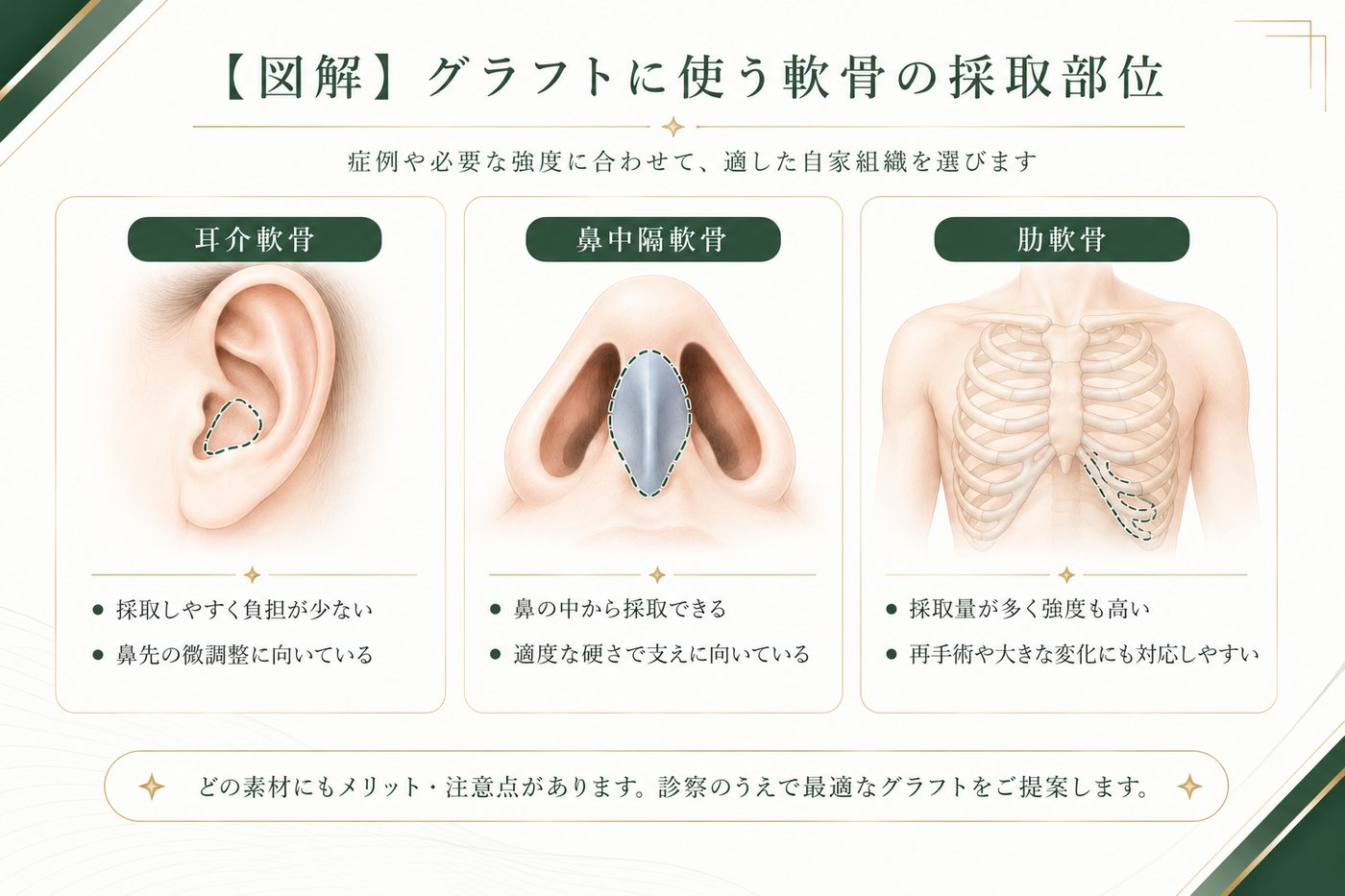
No compromise on the choice of cartilage (graft)
For procedures that need a solid foundation — such as septal extension, which lengthens the tip downward — your own rib cartilage (costal cartilage), with its strength, is sometimes the ideal material. However, harvesting rib cartilage demands real skill, so surgeons who cannot harvest it may substitute the easier-to-handle ear cartilage, or make preserved donor cartilage (cartilage donated by another person) their first choice.
Because Dr. Hane can harvest autologous rib cartilage himself, there are no constraints on the choice of material. Rather than relying on substitutes for the surgeon's convenience, he selects the material genuinely suited to each case. We consider your own tissue (autologous tissue) first, and propose the optimal graft according to the strength and volume required.* Every material has advantages and caveats; the final choice is made after an in-person examination.
Procedures & Cases by Concern
Rhinoplasty is rarely a single procedure: several techniques are combined to adjust the tip's height, definition, and angle together. All of the following are performed with the closed technique. Use the tabs on each case to switch between front, oblique, and side views.
Concern 1: Bulbous nose (rounded tip)
A bulbous nose — a tip that looks round — is almost never resolved by tip plasty alone. We use the closed technique to combine tip plasty, cartilage grafting, and a strut (a support that underpins the tip), building the tip's height and definition from the foundation up.
Case|Bulbous nose (rounded tip) / Closed technique: tip plasty + cartilage graft + strut
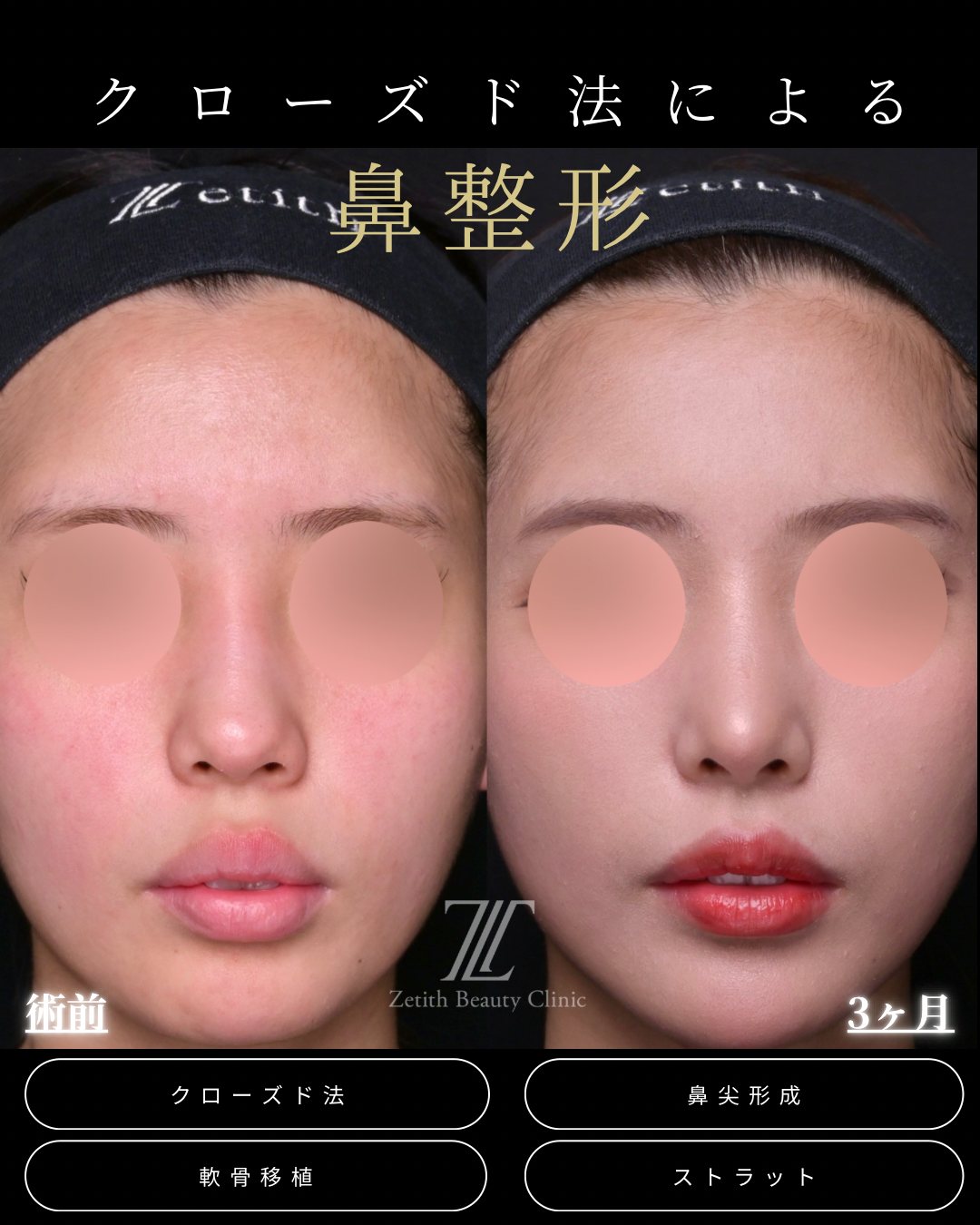
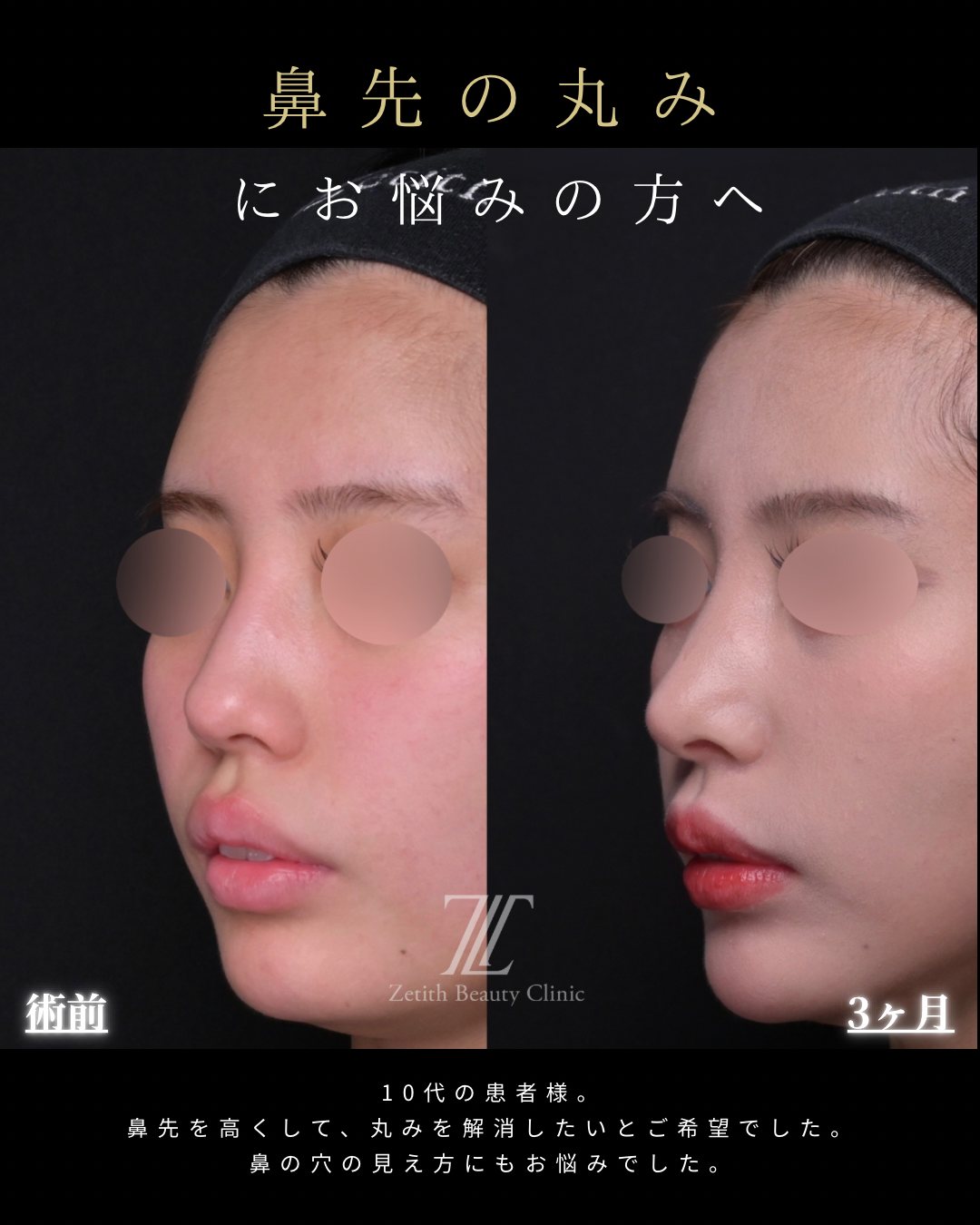
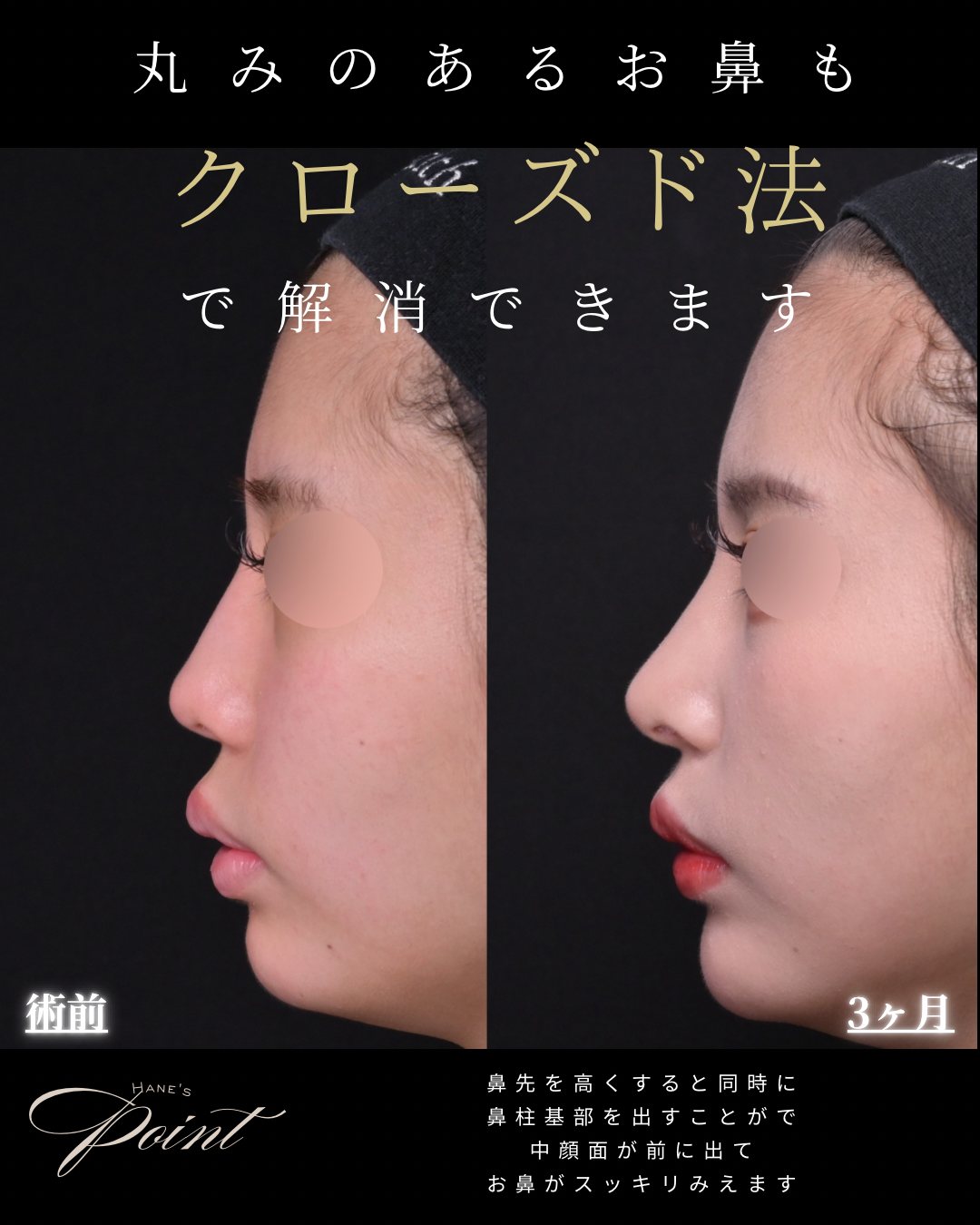
- Procedure
- Tip plasty + cartilage graft + strut via the closed technique (bulbous nose correction)
- Price
- ¥580,000〜 (varies with configuration)
- Main risks / side effects
- Swelling, bruising, asymmetry, infection, individual variation in results, etc.
- Downtime
- About 1–2 weeks (photos taken 3 months after surgery)
* Shown from three angles: front, oblique, and side. Patient in their teens (published with guardian consent; eye area edited to protect privacy). Results vary between individuals, and risks and side effects can occur. Self-funded treatment (not covered by insurance).
Concern 2: A low bridge (wanting a defined nose line)
If you want to define the bridge while also refining the tip, we use the closed technique to combine tip plasty, cartilage grafting, and a strut with dorsal augmentation (autologous tissue or an implant). The material used to raise the bridge can be autologous tissue (such as ear cartilage) or an implant, chosen to suit your nose and your wishes.* The case below used autologous tissue (ear cartilage).
Case|Low bridge / Closed technique: tip plasty + cartilage graft + strut + autologous dorsal augmentation (ear cartilage)
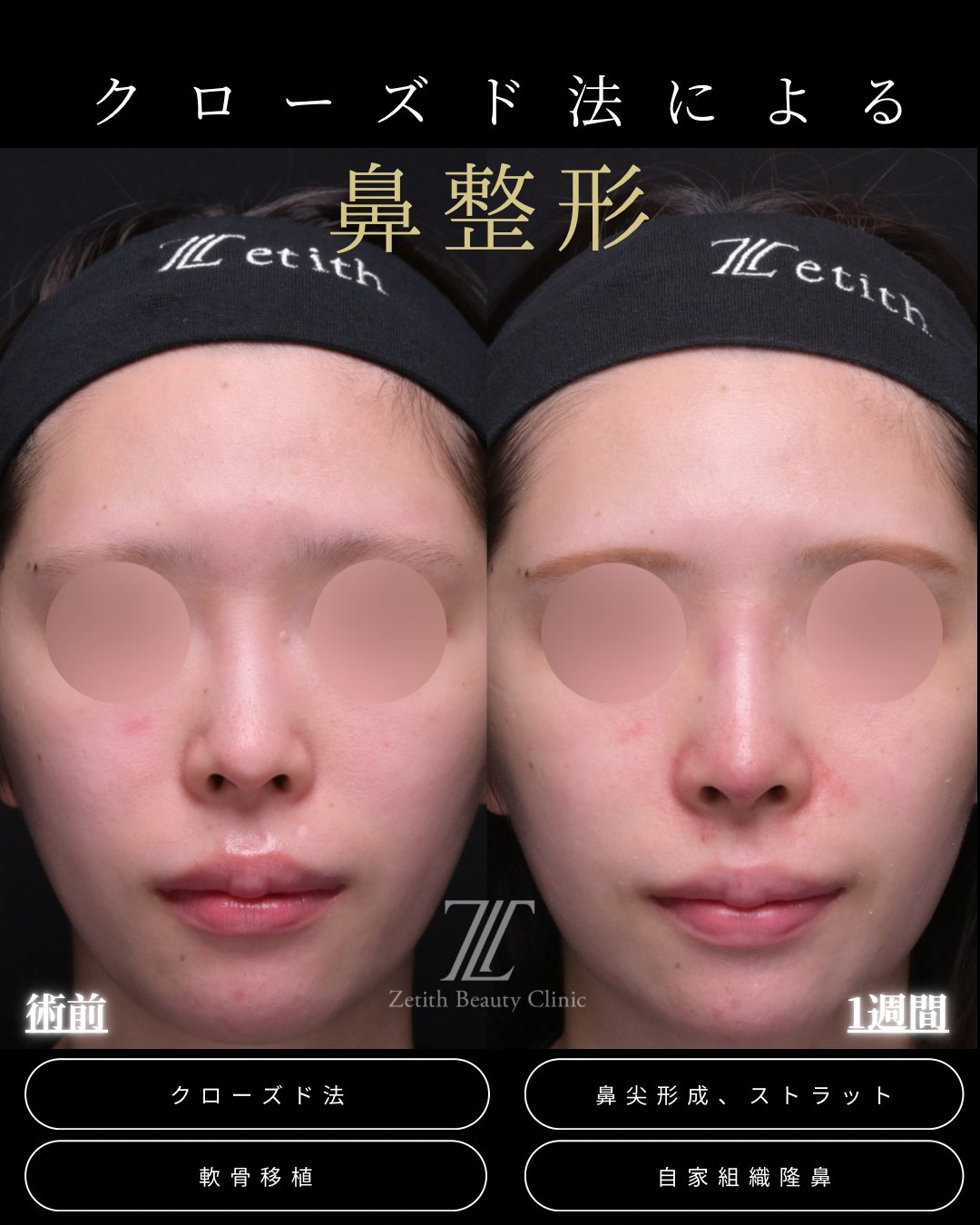
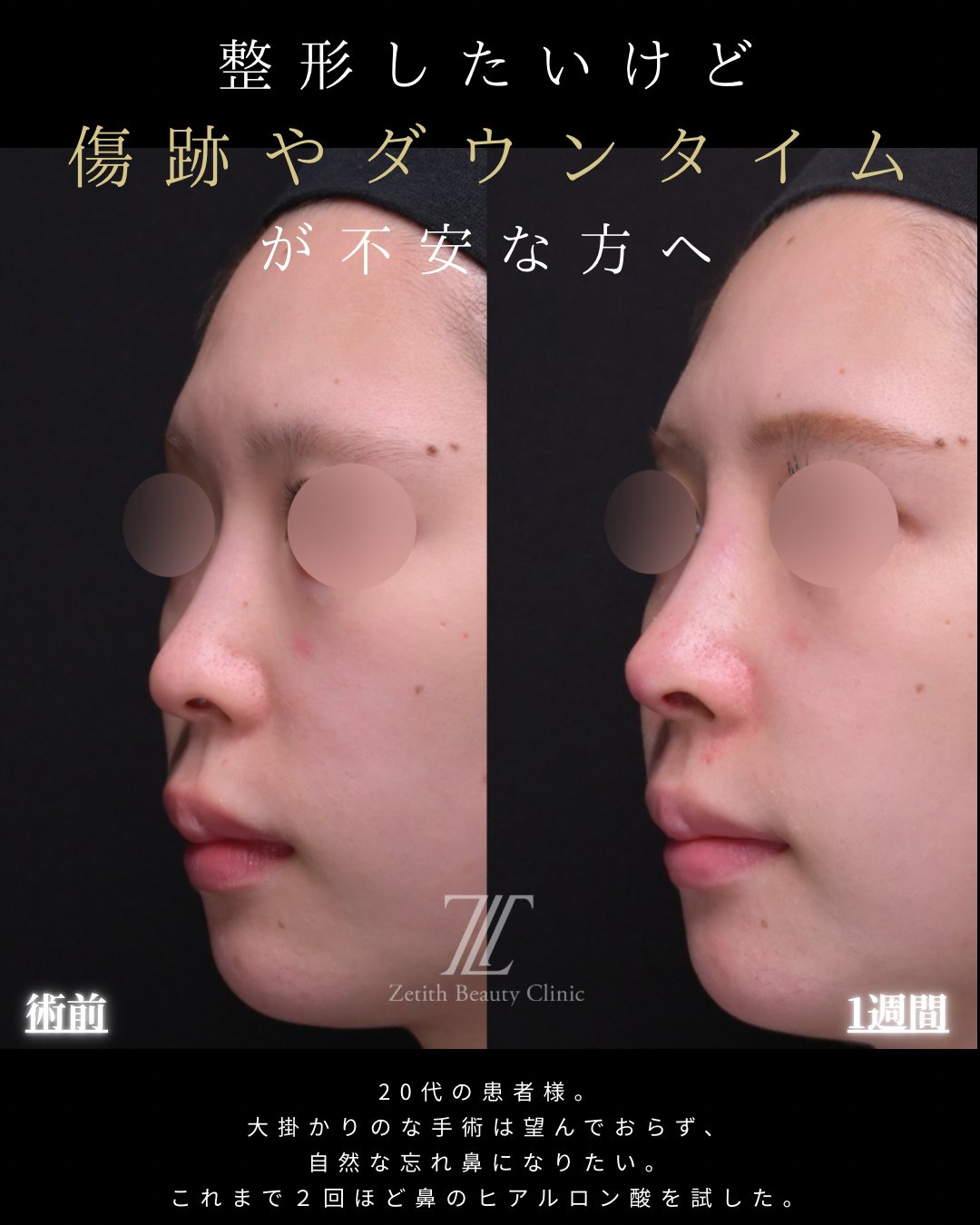
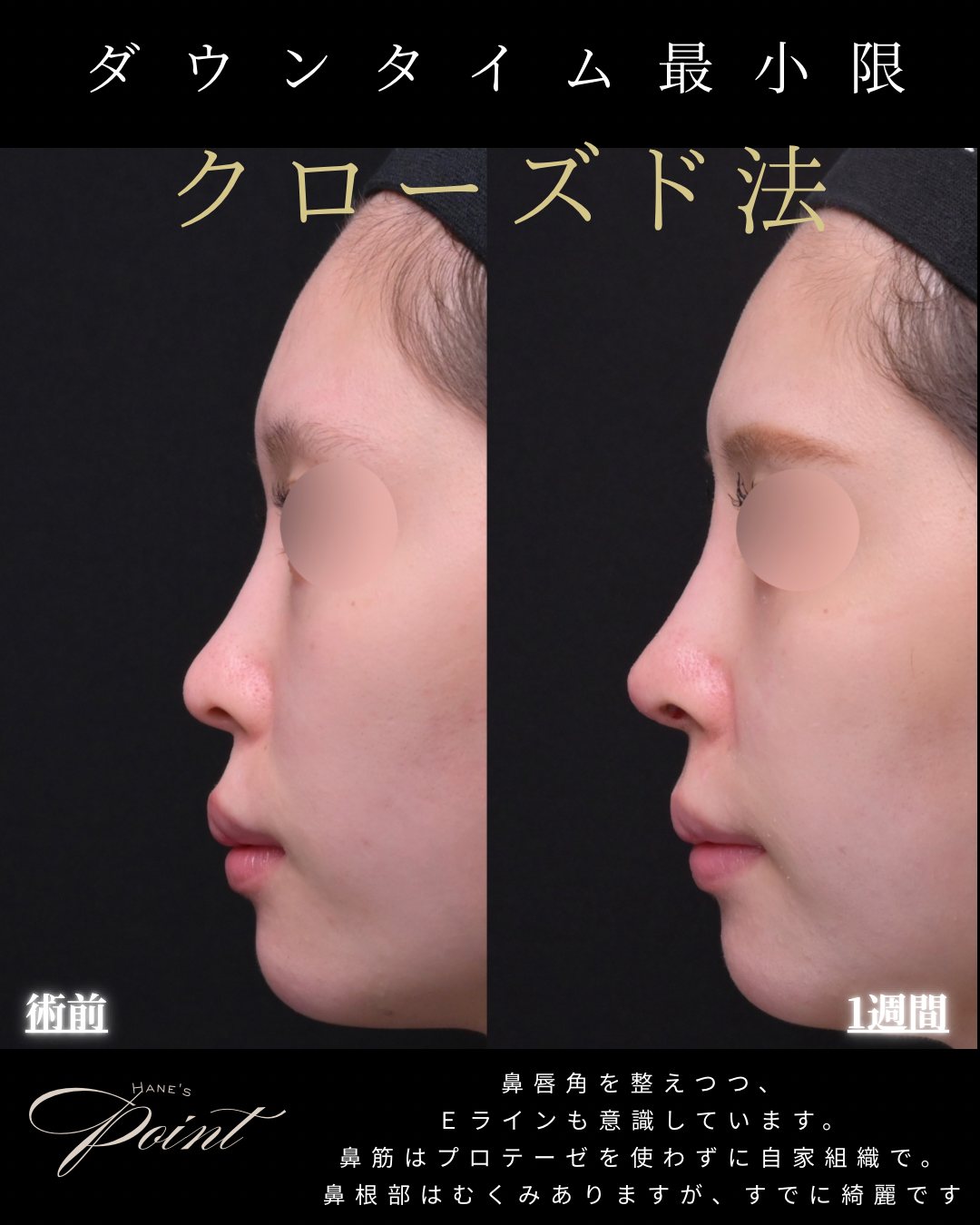
- Procedure
- Tip plasty + cartilage graft + strut + autologous dorsal augmentation (ear cartilage) via the closed technique
- Price
- ¥780,000〜 (varies with configuration)
- Main risks / side effects
- Swelling, bruising, asymmetry, infection, individual variation in results, etc.
- Downtime
- About 1–2 weeks (photos taken 1 week after surgery)
* Shown from three angles: front, oblique, and side. Patient in their 20s (published with consent; eye area edited to protect privacy). Results vary between individuals, and risks and side effects can occur. Self-funded treatment (not covered by insurance).
Concern 3: Wanting a taller, more projected tip
To bring the tip clearly higher and further forward, we use the closed technique to combine tip plasty, cartilage grafting, septal extension, an implant, and other techniques, designing the nose three-dimensionally from the foundation up.* Alar reduction is not a required procedure for raising the tip. In the case below, alar reduction was performed as well.
Case|Raising the tip / Closed technique: tip plasty + cartilage graft + septal extension (ear cartilage) + implant + alar reduction
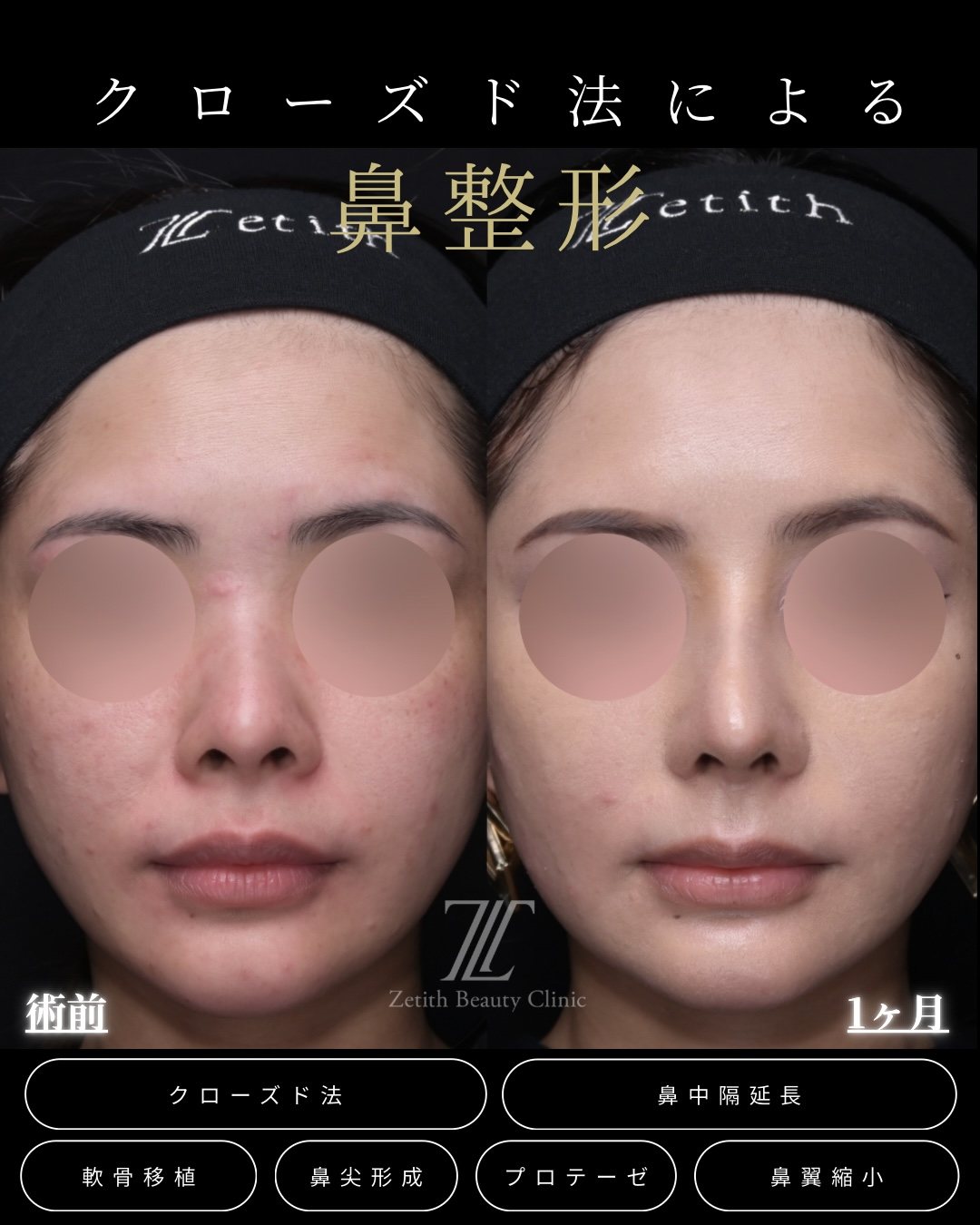
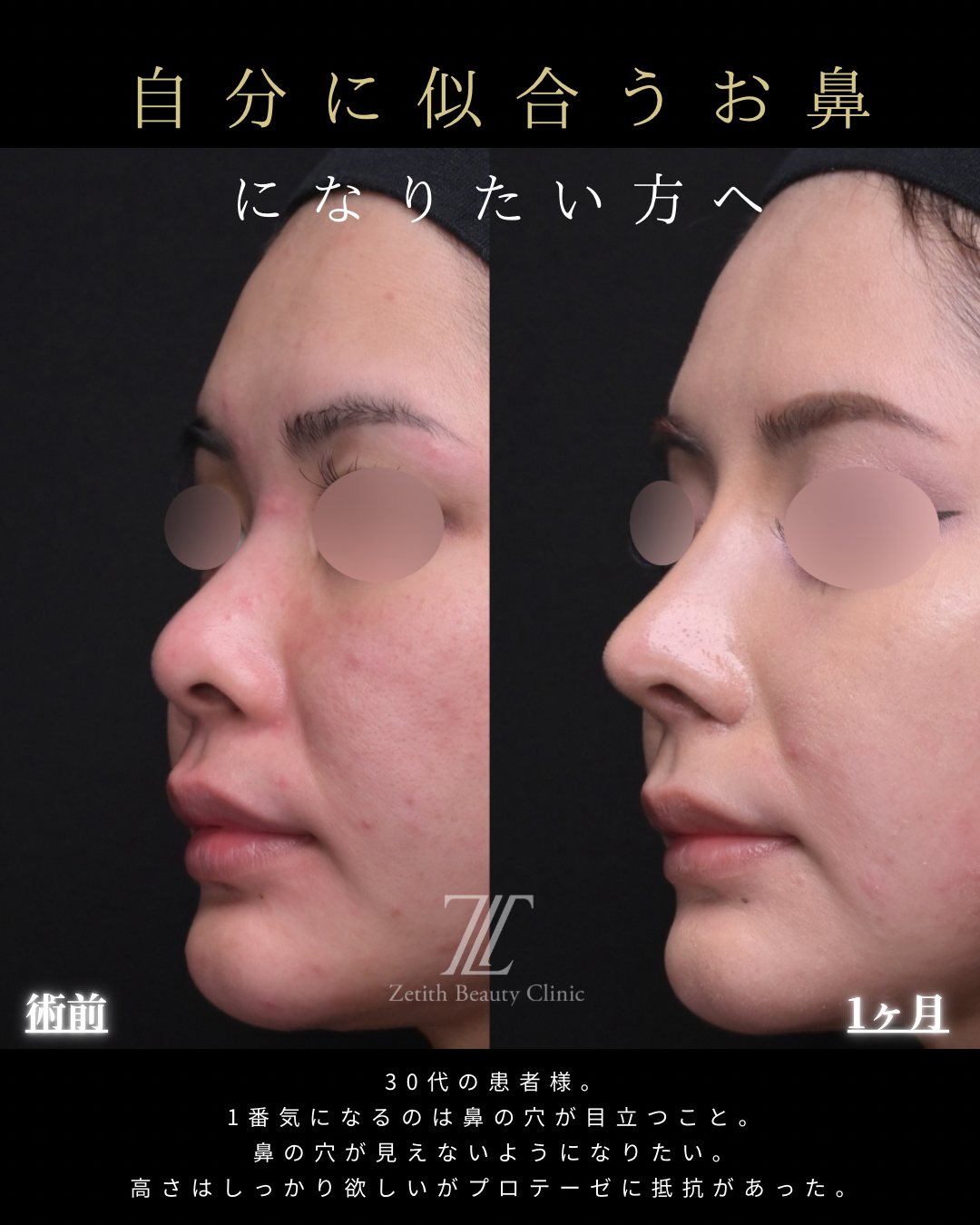
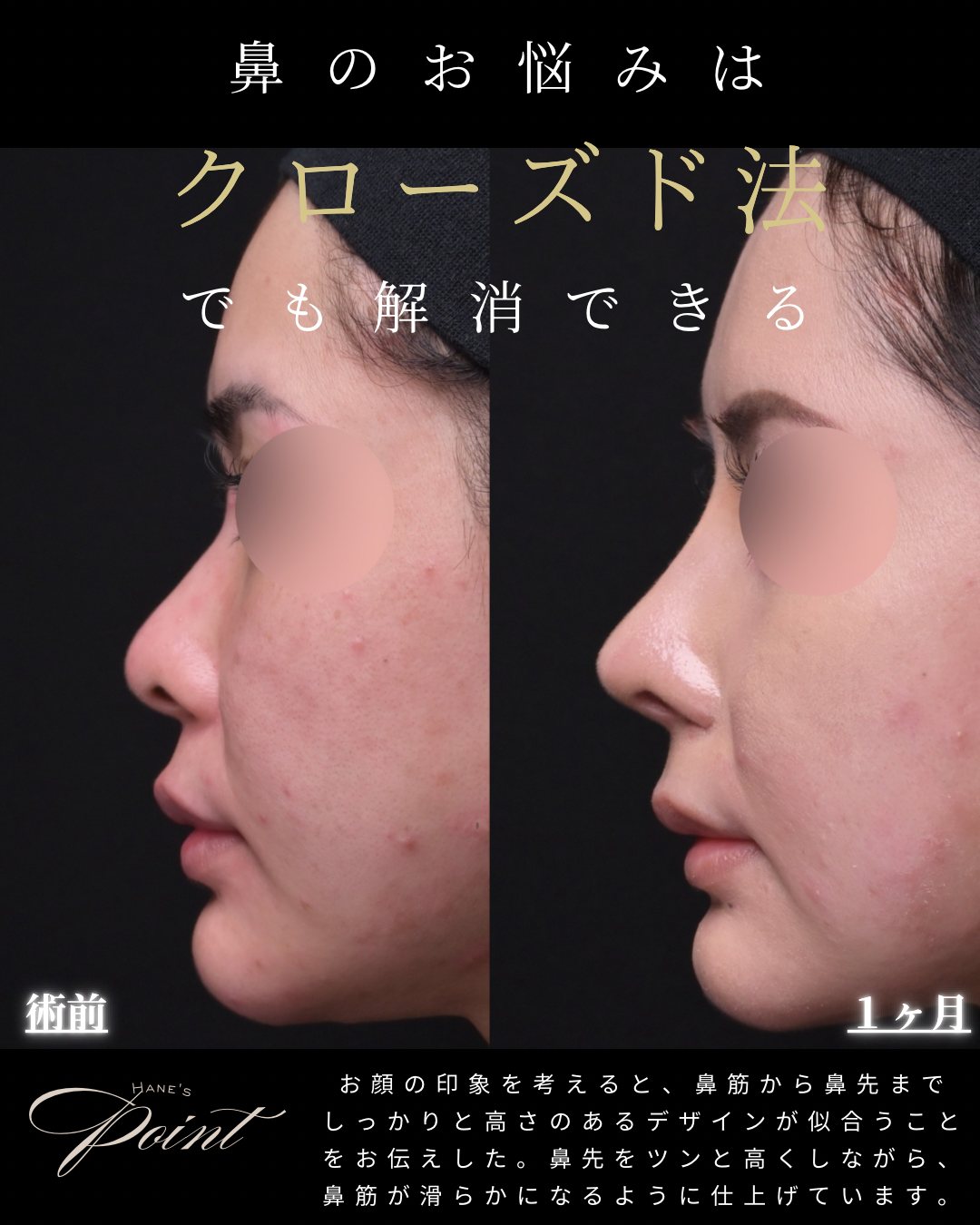
- Procedure
- Tip plasty + cartilage graft + septal extension (ear cartilage) + implant + alar reduction via the closed technique
- Price
- ¥1,080,000〜 (varies with configuration)
- Main risks / side effects
- Swelling, bruising, asymmetry, infection, implant displacement, individual variation in results, etc.
- Downtime
- About 1–2 weeks (photos taken 1 month after surgery)
* Shown from three angles: front, oblique, and side. Patient in their 30s (published with consent; eye area edited to protect privacy). Results vary between individuals, and risks and side effects can occur. Self-funded treatment (not covered by insurance).
Cost (Price Plans)
We use package pricing: the total is determined by adding the "options" you need to a "base plan" (the same for both the closed and open techniques). Typical procedure prices are below (tax included; self-funded treatment).
| Strut includes tip plasty & cartilage graft | ¥580,000〜Monthly ¥9,700〜 |
|---|---|
| Septal extension (ear cartilage) | ¥880,000〜Monthly ¥14,700〜 |
| Septal extension (with rib cartilage) | ¥1,100,000〜Monthly ¥18,300〜 |
| Dorsal augmentation (autologous tissue) | ¥330,000〜Monthly ¥5,500〜 |
| Dorsal augmentation (implant) | ¥242,000〜Monthly ¥4,000〜 |
Notes on pricing
Downtime & Recovery
Downtime differs by procedure. Use the following as a guide when planning your schedule (recovery varies between individuals).
| Procedure | Typical swelling / bruising | Splint & suture removal |
|---|---|---|
| Strut | Settles in 1–2 weeks | Cast splint; sutures out at about day 7 |
| Septal extension (ear cartilage) | Settles in 1–2 weeks | Cast splint; sutures out at about day 7 |
| Septal extension (with rib cartilage) | Settles in 1–2 weeks | Cast splint; sutures out at about day 7 |
| Dorsal augmentation | Settles in 1–2 weeks | Cast splint; sutures out at about day 7 |
Risks & Side Effects
Rhinoplasty is a medical procedure, and even with the closed technique the following risks and side effects can occur. Please be sure to review them.
Main risks / side effects
- Swelling, bruising, pain, puffiness (usually subsides over time)
- Asymmetry; a result differing from the image you had in mind
- Infection; scarring or tightness inside the nostrils; numbness or changes in sensation
- Possibility of implant displacement, visible contour, or exposure
- Procedures using threads may show some degree of relapse
How to Choose a Clinic & Surgeon in Fukuoka
Fukuoka (the Tenjin and Hakata areas) has many cosmetic clinics. To avoid regret, compare them on the following points.
Checklist for choosing a clinic
- 1. Rhinoplasty case volume & specialization: Do they have extensive nose cases and enough experience with the closed technique?
- 2. Do they explain what they cannot do?: Will they honestly tell you when the open technique is the better fit?
- 3. Design proposal skill: Do they propose designs based on the balance of your whole face?
- 4. Price transparency: Do they present a total that includes anesthesia and aftercare?
- 5. Thorough risk explanations: Do they explain the risks, not just the benefits?
- 6. Access & aftercare: Is the clinic easy to get to? Are post-op checkups and guarantees in place?
- 7. Do they show case photos from every angle?: Do they publish all three views — front, oblique, and side?
The point most often overlooked is how case photos are presented. The nose is a three-dimensional feature, and its impression changes completely depending on the viewing angle. Some clinics show only side or oblique views, but you can only judge the true result by seeing all three views, including the front. A tip that looks sharp from the side may show no columella from the front; a nose that looks beautiful from the front may show a drooping tip from the side — some clinics hide such issues by publishing only the flattering angles.
From Counseling to Surgery
So that first-time patients can consult with confidence, we guide you through the following steps.
- Book a free counseling session (Web / phone / LINE)
- Examination and design consultation with the surgeon (we review your concerns, wishes, and bone structure, and determine whether the closed technique can handle your case)
- Explanation of the procedure, costs, and risks (you decide only once you are fully satisfied)
- Surgery
- Aftercare and follow-up
Frequently Asked Questions
Does the closed technique really leave no scars?
The incisions are made only on the inside of the nostrils, so the outer skin is not cut and scars are barely visible from the outside. Scars do form inside the nostrils, but they usually become less noticeable over time. How scars heal varies between individuals depending on their constitution.
Which is better, the closed technique or the open technique?
It is not a simple matter of one being superior; they are used according to the condition of your nose and the result you are aiming for. Because we perform even septal extension with the closed technique, designs that clearly change your look can be pursued without visible scars. On the other hand, the open technique can be more suitable in cases requiring a wide surgical field, such as revision surgery or correction of severe deviation. We will propose the best method at your examination.
Can a bulbous nose be improved with the closed technique?
A bulbous nose is almost never resolved by tip plasty alone; we combine tip plasty, cartilage grafting, and a strut through the closed technique to rebuild the tip from its foundation. Suitability depends on the condition of your nose and is determined at counseling.
How long is the downtime?
It differs by procedure, but for tip plasty, strut, septal extension, and dorsal augmentation alike, swelling and bruising usually settle within about 1–2 weeks (cast splint; sutures out at about day 7). Recovery varies between individuals.
Is counseling free?
Yes, counseling is free of charge. To avoid crowding, we recommend booking in advance. You can book via the web, by phone, or on LINE.
أسئلة يمكنك طرحها بعد ذلك على الذكاء الاصطناعي
Rhinoplasty in Fukuoka That Leaves No Visible Scar
Based on your nose and the balance of your whole face, our surgeon will propose the plan best suited to you — including whether the closed technique can handle your case. Start with a free counseling session and feel free to ask anything.
* This article is intended to provide general medical information and does not guarantee results. The suitability, cost, and risks of treatment are determined individually through examination. The content and prices shown are for reference. Results vary between individuals. Rhinoplasty is a self-funded treatment (not covered by insurance).