
Key Takeaways
- Downtime varies by procedure, and the closed technique tends to be relatively short
- Expect swelling and bruising for 1–2 weeks and a nasal cast for about 7 days
- We recommend completing surgery 1–2 months before any major event
- Cooling, keeping your head elevated, and avoiding alcohol, exercise, and irritation help keep swelling from lingering
What Is Downtime? What to Expect
Downtime is the recovery period after surgery — the stretch of swelling, bruising, and puffiness before you're back to everyday life. With rhinoplasty, you can mainly expect the following.
What Typically Occurs After Rhinoplasty
- Swelling and puffiness: Peaks 2–3 days after surgery. Subtle residual puffiness resolves over several months
- Bruising: May appear around the eyes, usually fading within 1–2 weeks
- Nasal cast: Worn over the nose for about 7 days to stabilize the new shape
- Pain and tightness: Severe pain is uncommon and can almost always be managed with pain medication
Typical Downtime by Procedure
Downtime differs by procedure. Use the following as a guide when planning your schedule (recovery varies by individual).
| Procedure | Typical swelling / bruising | Cast & stitch removal |
|---|---|---|
| Strut incl. tip plasty & cartilage graft | Settles in 1–2 weeks | Nasal cast; stitches out at about 7 days |
| Septal extension | Settles in 1–2 weeks | Nasal cast; stitches out at about 7 days |
| Bridge augmentation (implant) | Settles in 1–2 weeks | Nasal cast; stitches out at about 7 days |
For details and pricing on each procedure, see our complete guide to the closed technique.
The Recovery Timeline (Day of Surgery to 1 Month)
Here is a typical recovery course with the closed technique (individual results vary).
- Day of surgery to day 3: Peak swelling and bruising. Nasal cast in place. Pain managed with medication. Rest quietly.
- Days 3–7: Swelling gradually begins to subside. Cast and stitches removed at about day 7.
- Weeks 1–2: Major swelling settles — most people feel comfortable seeing others. Subtle puffiness remains.
- Weeks 3–4: An even more natural appearance. Exercise and other activities can gradually resume.
- Months 1–3: Puffiness resolves and the nose settles into its final shape.
Watch the reel on Instagram →
The Closed Technique Means Shorter Downtime
The closed technique makes incisions only inside the nostrils, leaving the skin of the columella (between the nostrils) uncut. As a result, swelling and bruising tend to subside sooner.
Because no scar shows on the outside, another advantage is that you're less likely to have that "just had surgery" look during downtime.
Tips for a Shorter, Easier Downtime
How you spend your downtime matters too. Keeping the following points in mind helps prevent swelling from lingering.
Tips to Keep Swelling From Lingering
- Cool the area for the first 2–3 days: This blunts peak swelling (avoid excessive warming afterward)
- Rest with your head elevated: Use a higher pillow when sleeping to reduce puffiness
- Avoid irritation: No forceful nose-blowing, sleeping face-down, or bumping the nose
- Alcohol, intense exercise, saunas: Anything that boosts circulation too much prolongs swelling — hold off for a set period
- No smoking: Smoking impairs healing, so avoid it as much as possible before and after surgery
- Go easy on salt: Watch your sodium intake to help control puffiness
Case Photos (1 Week Post-Op)
See the results at 1 week post-op from three angles — front, oblique, and profile — as a reference for how quickly recovery progresses. Use the tabs to switch angles.
Case | Closed technique: tip plasty + cartilage graft + strut + autologous augmentation (ear cartilage) / 1 week post-op
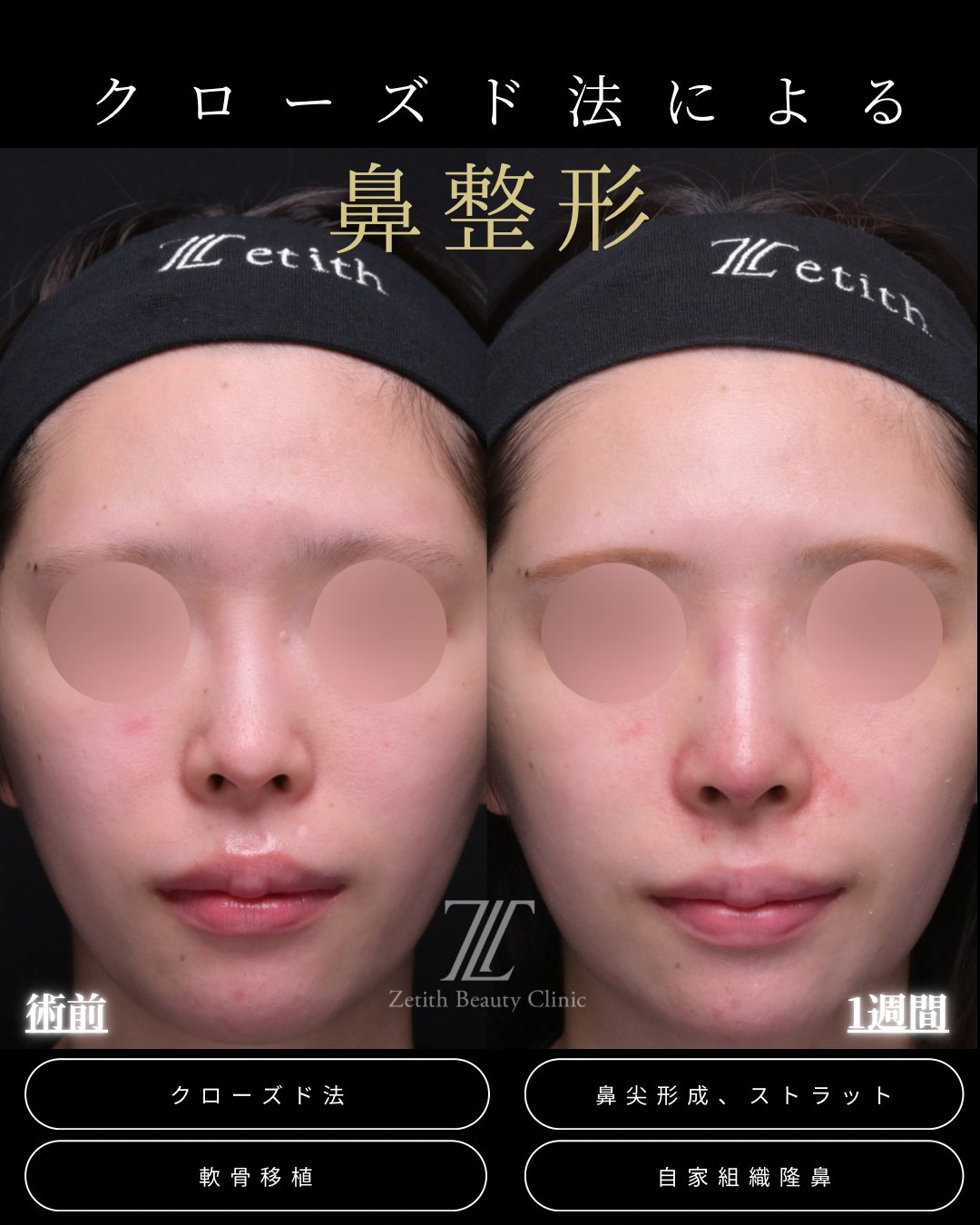
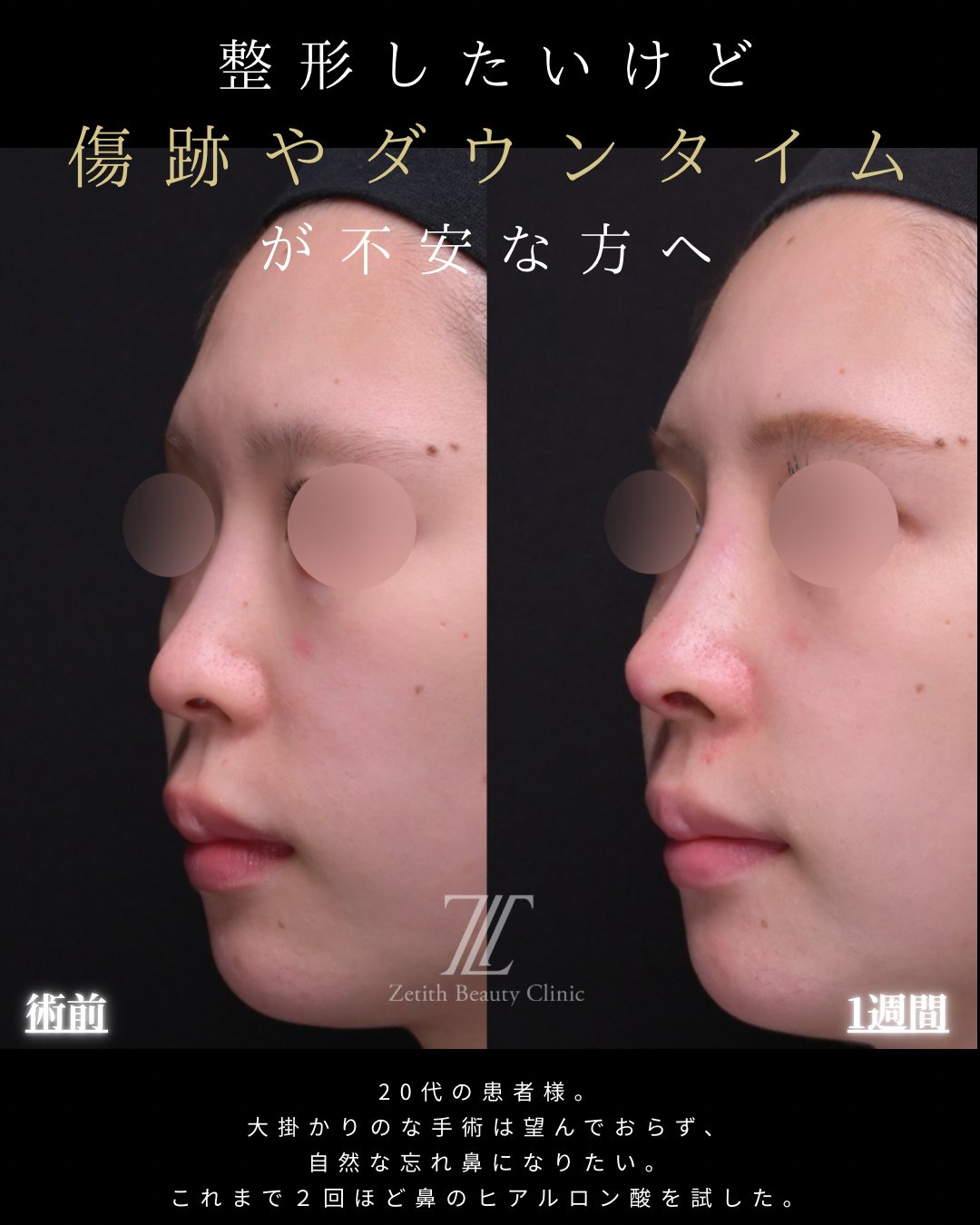
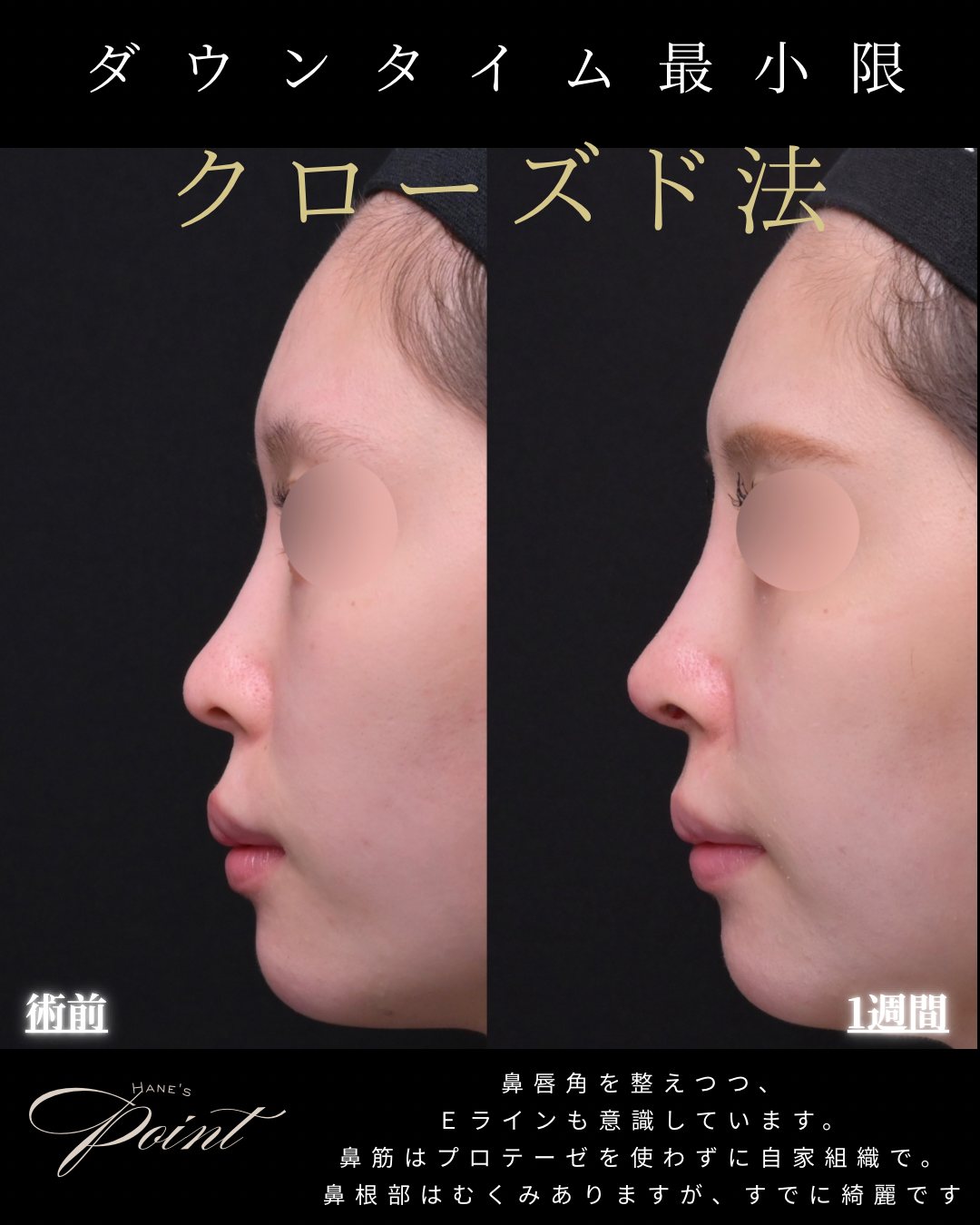
- Procedure
- Closed-technique tip plasty + cartilage graft + strut + autologous augmentation (ear cartilage)
- Price
- ¥780,000〜 (varies by combination)
- Main risks / side effects
- Swelling, bruising, asymmetry, infection, individual variation in results, etc.
- Downtime
- About 1–2 weeks (photos taken 1 week post-op)
* Photos shown from three angles: front, oblique, and profile. Patient in her 20s (published with consent; eye area edited to protect privacy). Results vary by individual, and risks and side effects may occur. This is an elective (non-insured) procedure.
Risks & Side Effects
Recovery timelines vary by individual, and the risks and side effects below may occur. If anything concerns you, don't try to judge it yourself — contact us right away.
Main Risks & Side Effects
- Swelling, bruising, or puffiness may last longer than expected
- Asymmetry, or a result that differs from the envisioned outcome
- Infection, wounds or tightness inside the nostrils, numbness or changes in sensation
- If an implant is used, possible displacement or a visible outline
Frequently Asked Questions
When can I go back to work?
For desk work, most patients plan on a few days to a week — around when the cast comes off (about 7 days post-op). If your job puts you in front of people, we recommend building in extra time based on how your swelling subsides.
When can I wear makeup again?
Makeup on areas other than the nose is usually possible fairly early; for the nose itself, wait until the cast is off and stitches are removed. This varies by procedure, so we'll advise you at your appointment.
When can I exercise or drink alcohol?
Anything that boosts circulation too much prolongs swelling, so we recommend avoiding intense exercise, alcohol, and saunas for about 2–4 weeks after surgery. The timing depends on your procedure.
When can I wear glasses again?
For procedures that place structural support along the nasal bridge, we'll ask you to avoid putting pressure on the nose for a certain period. We'll give you a timeline at your appointment.
My swelling isn't going down. Should I be worried?
Subtle puffiness often takes several months to settle. However, if you have severe swelling, pain, or redness, don't try to judge it yourself — contact us as soon as possible.
پرسشهایی که میتوانید در ادامه از هوش مصنوعی بپرسید
Anxious About Downtime?
At your counseling session, we can also plan around your time off and upcoming commitments. Our surgeon will examine you and propose an approach that fits your lifestyle.
* This article is intended to provide general medical information and does not guarantee results. Suitability, costs, and risks of treatment are determined individually through examination. Results vary by individual. Rhinoplasty is an elective procedure not covered by insurance.